Claude Fable 5.2: pricing and access
Anthropic released Claude Fable 5.2 on November 9, 2026, alongside Claude Mythos 5.2. It's the same model under 2 names. Fable carries safeguards in cybersecurity and biology, which makes it possible to open it to everyone. Mythos is reserved for verified organizations.
According to Anthropic's announcement, it responds up to 30% faster than Fable 5.1, at a lower API price.
| Question | Answer |
|---|---|
| Who has access | Paid plans: Pro, Max, Ultra, Team and Enterprise. |
| Max and Ultra | Included, up to 50% of the weekly quota. |
| Pro and standard Team seats | Pay-as-you-go, in credits. Included from November 9 through 16, 2026 (launch offer). |
| Where to use it | The Claude app, Cowork and Claude Code (version 2.1.321 or later). |
| API pricing | $8 per million input tokens, $40 for output ($10 and $50 for Fable 5.1). |
If you have a Pro plan, this is the week to try it. Through November 16 at 11:59 pm PT, Fable is included in your quota, up to 50%. After that, it goes back to usage credits. The details are in Claude's help page on the launch offer and in the page on Fable models by plan.
Fable uses up your quota faster than the other models. Keep an eye on the usage page in your settings.
Benchmark: 41% of real freelance projects completed end to end
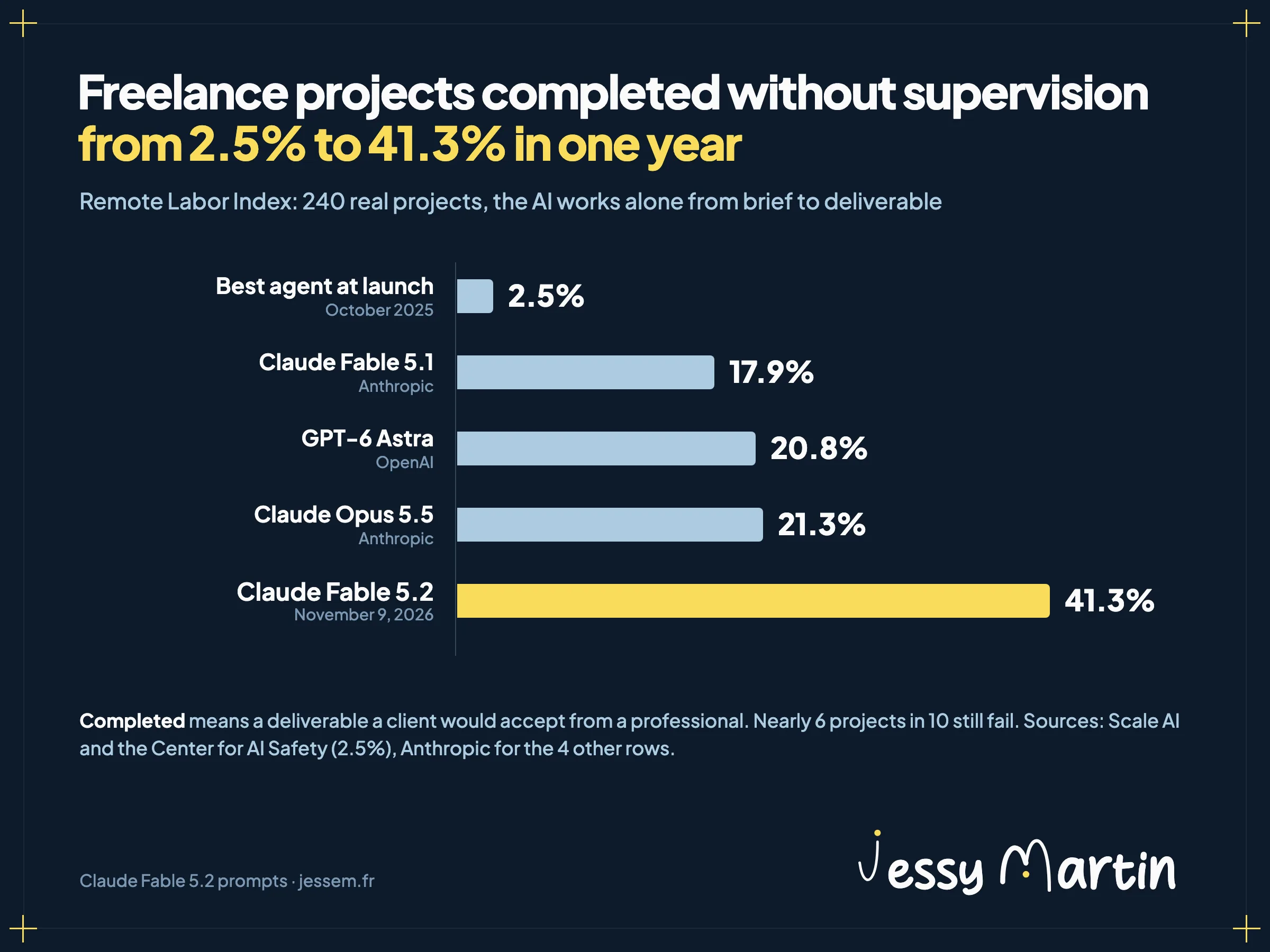
One line in Anthropic's results table carries a little-known name: Remote Labor Index. Fable 5.2 scores 41.3% on it.
Scale AI and the Center for AI Safety created this test and published it in October 2025. It gathers 240 projects actually commissioned from freelancers, across 23 domains: development, design, architecture, data analysis. The freelancers who completed them were paid $143,991 in total. The method is described by Scale AI and in the research paper.
How the test works: the AI receives the client's brief, works alone and hands back its deliverable. The project counts as completed if the result reaches the level a client would accept from a professional. Only a project delivered in full counts.
| Model or agent | Projects completed | Source |
|---|---|---|
| Best agent when the test launched (October 2025) | 2.5% | Scale AI |
| Claude Fable 5.1 | 17.9% | Anthropic |
| GPT-6 Astra | 20.8% | Anthropic |
| Claude Opus 5.5 | 21.3% | Anthropic |
| Claude Fable 5.2 | 41.3% | Anthropic |
The last 4 rows come from the table published on the Claude Fable 5.2 page. The score nearly doubled between Opus 5.5 and Fable 5.2. A year ago, the best agent completed 2.5% of these projects.
This figure has 2 limits. Anthropic publishes these results, with Fable 5.2 set to "high" effort. And nearly 6 projects in 10 still fail. Completing a project is a long way from doing the job: the test doesn't cover the client relationship or accountability for the result.
The demos circulating since Monday point the same way. In a video from the Claude channel, the model designs a working living-room voice assistant: circuit board, enclosure and software. According to the announcement, the request fit in one paragraph. On Reddit, a thread presents a playable shooter built in Unreal Engine with a 3-line prompt, according to its author.
For a marketing team, this covers the work you'd brief out to a vendor, such as a landing page or a data analysis. You can now try that with this model. Your work shifts to the brief upstream and the review downstream.
Orchestrating a hard task with Fable 5.2: the hub-and-spoke method
On the model's page, Anthropic presents Fable 5.2 as its best lead agent. According to its tests, it runs ambiguous engineering work for days and coordinates hundreds of subagents. A Datadog engineer quoted in the announcement compares it to an incident commander, who sends faster models to look for the first signals and coordinates the response.
That's how I use it on a hard task. Alone, it reads everything itself, fills its context and bills every page it scans at full price. As an orchestrator, it keeps what takes judgment and hands out the rest.
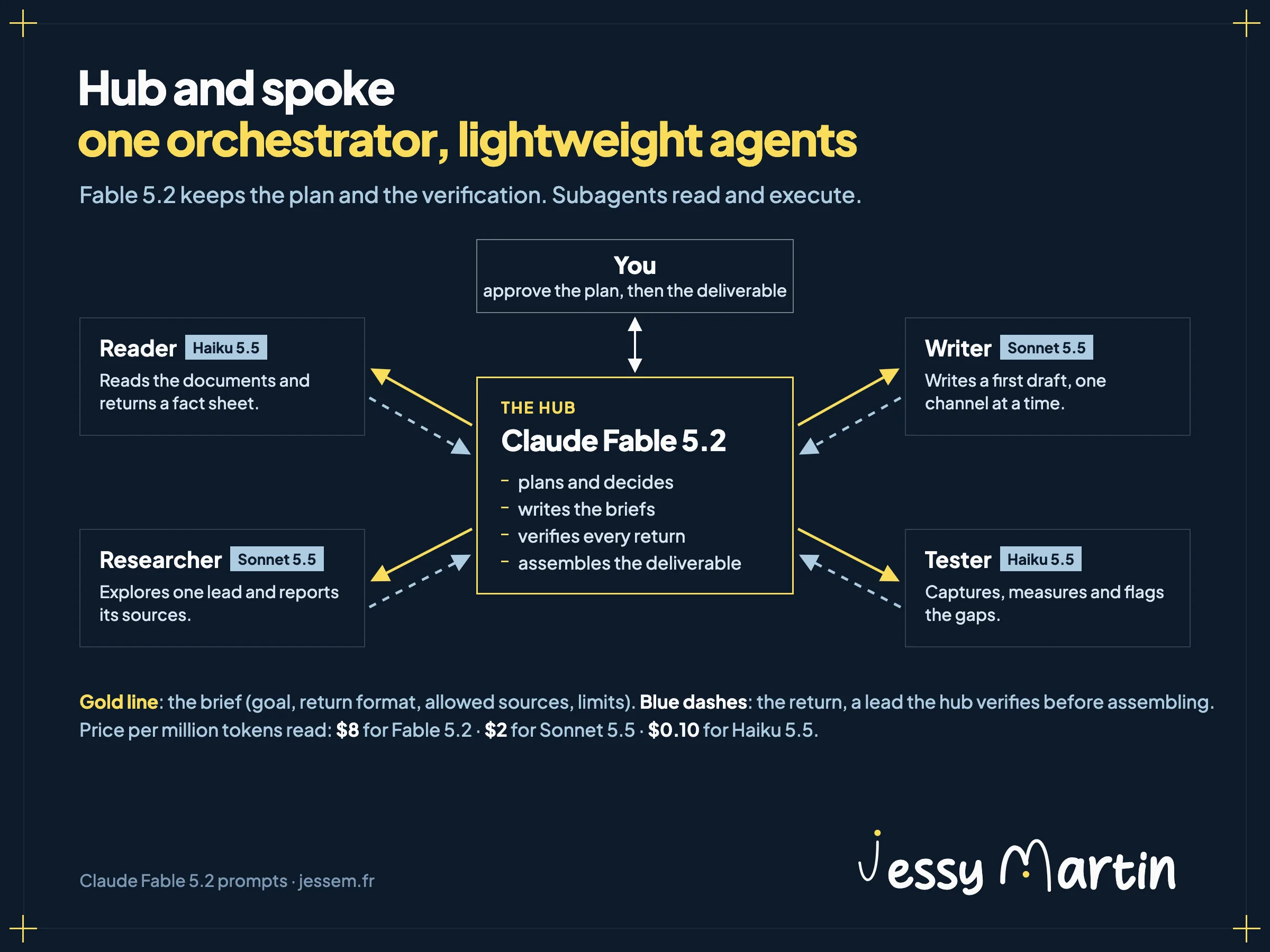
This setup is called hub and spoke, after the hub and spokes of a wheel. At the center, the hub. Fable 5.2 plans, writes the briefs, verifies every return and assembles the deliverable. Around it, the spokes. These are subagents on lighter models, each with a narrow mission and its own context window. They read, search, write a first draft or test, then hand back a condensed result.
Why lighter subagents
Price first. According to the API pricing, a million tokens read costs $8 with Fable 5.2, $2 with Sonnet 5.5 and $0.10 with Haiku 5.5 on standard requests. A reading job handed to Haiku costs 80 times less.
Quality next. Anthropic measured the effect on its own research system: a lead agent backed by lighter subagents outperformed a single agent of the same level by 90.2% on its internal evaluation. Each subagent explores its own line of inquiry in a fresh context, then condenses what it found. The full write-up is in Anthropic's article on its multi-agent system.
The same article spells out the downside: a multi-agent system uses about 15 times more tokens than a chat. Reserve it for tasks whose value justifies the spend.
When to orchestrate
| Orchestrate with subagents | Keep a single agent |
|---|---|
| The task is broad: many sources or files to read. | The change is quick and targeted. |
| The subtasks are independent of one another. | Each step depends on the previous one. |
| A step produces a lot of text, and you only need the summary. | You talk to it often along the way. |
| The deliverable is worth several hours of human work. | The answer fits in one conversation. |
These criteria come from the Claude Code subagents documentation and from Anthropic's article. The last row is mine.
My 6 orchestration rules
- The hub keeps the judgment. The plan, the trade-offs, the verification and the final writing stay with it. A spoke gets a task that can be described in one sentence.
- A 4-point brief per subagent. Its goal, the format of its return, the sources and tools it may use, the limits of its task. That's Anthropic's list, and it holds up in practice. A subagent starts without the conversation history: it knows only that brief and the project's instruction files.
- A team sized to the task. Anthropic gives its rules of thumb: 1 agent for a simple fact, 2 to 4 subagents for a comparison, more than 10 for broad research. In October, I launched 6 in parallel on 121 entries to enrich. The session's web search quota, shared among them, ran out around the 8th entry of each batch. Since then, I count shared resources before setting the number of spokes.
- One model and one effort level per role. Without a setting, a Claude Code subagent runs on the conversation's model: your spokes then work on Fable, at Fable's price. In early November, the weekly limit on my strongest model cut a subagent off mid-job. Since then, execution and routine reviews run on Sonnet. The strongest model keeps the final review and the sensitive topics.
- Every return is a lead to verify. In August, an audit subagent handed me a detailed report full of figures. The Program section of my 13 training course pages was empty, it wrote. Each page listed 5 or 8 modules. It had read the introductory sentence and drawn its conclusion. So the hub checks everything it's about to assert against the source itself.
- 2 human checkpoints. You approve the plan before execution, then the deliverable before it goes out. Between the 2, the rules that must never be broken are enforced in code: the method is in Controlling your AI agents with Claude Code hooks.
Rule 4 is set in a file. Each Claude Code subagent has its own, in the .claude/agents/ folder, with its model, its effort level and its tools.
---
name: source-reader
description: Reads a batch of documents and returns a fact sheet for each
tools: Read, Glob, Grep
model: haiku
effort: low
---

You read the documents you're given. For each one, return a sheet:
the 5 most useful facts, each with its page or line.
Report the facts as they are written. Leave conclusions to the
orchestrator.
If a piece of information is missing, write "absent".
This reader has only 3 read tools: it can't modify anything. The /tasks command shows the model of each running subagent. A subagent is a full agent, with the 5 components described in What is an AI agent? The 5 components of a new hire.
Prompting Fable 5.2: 5 rules from the official guide
Anthropic published a prompting guide specific to this model. It's written for developers. 5 of its tips also change the result of marketing work.
- Drop your old instructions. Fable 5.2 follows instructions very closely. A rigid style rule or a precaution forgotten in a memory file will be applied to the letter. Reread what you've carried over from older models.
- Tell it the project is its own. In Anthropic's tests on small coding tasks, this sentence led it to merge repeated code in about half the trials, compared with fewer than 1 in 10 without it. The model also made changes nobody had asked for. Review what it touched.
- Ask it to see the work through. On a long task, it sometimes stops before the end, with a list of what remains. A paragraph asking it to finish cut these stops by about half, at the cost of 30% more tokens.
- Approve with a precise sentence. Write "yes, publish the page to the test environment" where you would have written "continue". The model applies your approval rules as they are written.
- Let it work and require a recap. It can chain long series of actions without writing you anything. Ask for one line at the start on what it's about to do, and a final recap that stands on its own.
The guide adds 2 settings that help with orchestration. "Low" effort suits fast subagents, and "high" suits the hub's long, difficult tasks. And precautions accumulate from one agent to the next. In Anthropic's tests, a single forgotten "never retry" note in the context cut retries from nearly every time to 4 in 10. Clean up what your agents pass to each other.
The orchestration charter to paste before every mission
An orchestration prompt has 2 layers. The charter carries the method and stays the same from one mission to the next. The mission brief carries the subject matter.
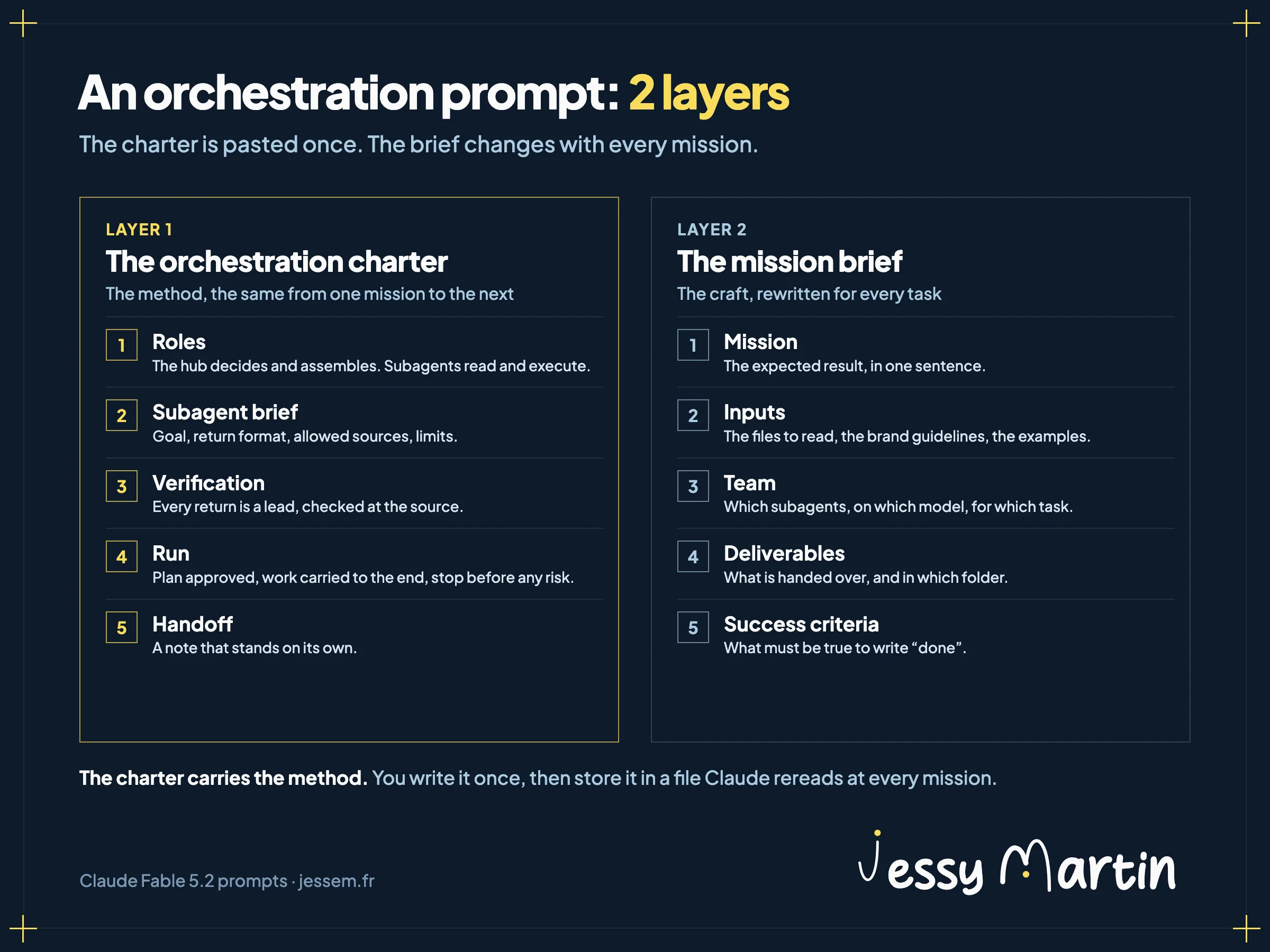
The charter restates the 6 rules and the wording of the official guide.
You are the orchestrator of this mission. The project is yours: its
structure and its choices are up to you.

ROLES
- You: the plan, the decisions, the verification and the final assembly.
- Your subagents: reading, collecting, first drafts, tests. Launch them
  on a lighter model (Haiku to read and check, Sonnet to produce), in
  parallel when their tasks are independent.
- Team size: 1 subagent for a simple fact, 2 to 4 for a comparison.
  Beyond 8, ask for my approval.

BRIEFING EACH SUBAGENT
Give it 4 things: its goal, the exact format of its return, the files
and sources it may use, what falls outside its scope.
It knows only this brief: write it for someone with no context.

VERIFICATION
Treat every return as a lead. Before relying on it, check the figures
and quotes yourself in the source.

RUN
1. Present your plan: steps, planned subagents, what each will hand
   back. Wait for my approval.
2. Execute to the end. When you hit an ordinary obstacle (error, missing
   file, failing tool), find the cause and work around it.
3. Stop before any risky or irreversible action.

HANDOFF
End with a note that stands on its own: what is done, what you verified
and how, what remains uncertain, what I should review first.
Keep this charter in a separate file, orchestration.md, and open each mission with "Read orchestration.md". Subagents also load the project's CLAUDE.md file, so a charter placed there would make each of them think it's the orchestrator.
The 10 briefs that follow are built from the official guide, the subagents documentation and what my agents produce every week with Claude Code. The durations and costs measured on Fable 5.2, brief by brief, will come in an update. The brackets are for you to replace.
3 prompts to produce content
1. A study turned into a full campaign
When: a study or a white paper sits in a folder. To prepare: the PDF, your brand guidelines, 3 pieces of content that sound like you.
MISSION
Turn the study sources/[study].pdf into a full campaign for
[MY AUDIENCE].

INPUTS
The study, charts included. My guidelines: brand-guidelines.md.
3 pieces that sound like me: content/examples/.

TEAM
- Readers (Haiku): one per chapter. Return: a fact sheet, each figure
  with its page.
- You: you pick the 5 key figures and the campaign angle.
- Writers (Sonnet): one per channel, launched after your pick.
- Brand reviewer (Sonnet): checks each text against the guidelines.

DELIVERABLES, in content/campaign-[name]/
A one-page note (the 5 figures and their page), a 900-word article,
4 LinkedIn posts with different angles, 3 emails, the outline of an
8-page carousel.

SUCCESS CRITERIA
Every published figure can be found in the study, on the page given:
you verified it yourself. No channel reuses a sentence from another.
The reviewer no longer flags any gap with the guidelines.
Why this team: the readers go through the study in parallel for a fraction of the price. Choosing the 5 figures stays with the hub, because that decision makes the campaign.
2. A quarter of content drawn from your archives
When: the calendar for the quarter is empty. To prepare: your published content in a folder, an export of its stats.
MISSION
Build my editorial calendar for the next 12 weeks and write the first
4 pieces.

INPUTS
My published content: content/published/. Its stats:
sources/stats-[period].csv. My guidelines: brand-guidelines.md.

TEAM
- Readers (Haiku): one per batch of 20 pieces. Return: a table of
  topic, angle, format, date.
- Analyst (Sonnet): cross-references that table with the stats. Return: what
  was read, what was ignored, what was never covered.
- You: you settle the 12 topics and present them to me before writing.
- Writers (Sonnet): one per piece, after I approve the topics.

DELIVERABLES
The calendar as an Excel table (one topic per week, its angle, its
format, the evidence it rests on) and 4 written pieces.

SUCCESS CRITERIA
Each topic rests on a figure from my stats or on a gap found in my
archives. No topic repeats a piece already published.
Why this team: this brief adds a checkpoint. The 12 topics go through you before a single writer starts.
3. A presentation video written in code
When: an offer to present, with no shooting budget. To prepare: your brand guidelines, your logo, the description of the offer. The full method is in Brand motion design with Claude Code and HyperFrames.
MISSION
Make a 30-second video presenting [MY OFFER] to [MY AUDIENCE], in
animated HTML rendered to MP4 with HyperFrames.

INPUTS
My guidelines (colors, fonts, logo): [FOLDER].
The offer: content/[offer].md.

TEAM
- You: the director. You write the script in 5 shots and wait for my
  approval.
- Builder (Sonnet): builds the shots in animated HTML.
- Checker (Haiku): captures one frame per shot and measures what
  overflows the frame, text shown for less than 2 seconds, and colors
  outside the guidelines. Return: a list of issues, shot by shot.

DELIVERABLES
The approved script, the MP4, the list of fixed issues.

SUCCESS CRITERIA
The checker flags no more issues. You looked at the last frame of
each shot yourself before delivering.
Why this team: the one who builds and the one who checks are 2 different agents. An agent is a poor judge of its own work.
2 prompts for analysis
Fable 5.2 reads charts better. On Chartography, a chart-reading test, it scores 73.4%, up from 44.8% for Fable 5.1, according to the model's page. So in an analysis, the hub reads the charts itself.
4. A performance review from your dashboards
When: the charts are there, the commentary is still to be written. To prepare: screenshots of your dashboards and the exports that go with them.
MISSION
Do the marketing performance review for [PERIOD] and come up with
3 decisions.

INPUTS
Screenshots of my dashboards: sources/screenshots/.
The exports: sources/exports/ (CSV or Excel).

TEAM
- You: you read the charts in the screenshots yourself and note each
  value with its unit. That's your strength: don't delegate it.
- Analysts (Haiku): one per export. Return: the totals, the 5 biggest
  rises and the 5 biggest drops, with the column name.
- Verifier (Sonnet): recomputes 5 randomly chosen figures from the raw
  files.

DELIVERABLES
One page: what is improving, what is slipping, 3 decisions for the
month, each backed by a figure and its source.

SUCCESS CRITERIA
The values read from the screenshots and those in the exports match,
or the gap is flagged. An unreadable value is written down as
unreadable.
Why this team: 2 independent sources, the screenshots and the exports, check each other. The verifier doesn't know the hub's conclusions.
5. A performance report read in Search Console
When: before an SEO plan. To prepare: Claude Code in the desktop app, and your Search Console login open in its browser.
MISSION
Write the performance report for [MY SITE] over 3 months, with
10 priorities ranked by expected gain.

INPUTS
My Search Console, open in the app's browser: I approve the
connection. The site repo: sitemap.xml and the pages.

TEAM
- You: you drive the browser alone and pull the tables (pages,
  queries, indexing, last 28 days against the previous 28). A browser
  can't be shared between agents.
- Analysts (Sonnet): one per group of queries, from the tables you
  pass them. Return: the pages with many impressions and few clicks.
- Indexing checker (Haiku): for each unindexed page, checks in the repo
  whether it's in the sitemap and which pages link to it.

DELIVERABLES, in content/reports/
The report: overview, pages, queries by group, indexing, 10 priorities.

SUCCESS CRITERIA
Every figure comes from a table you read. Any estimate is marked as
one. Every unindexed page has a probable cause.
I ran a first version of this mission on jessem.fr on the day I'm writing these lines, without subagents. Fable 5.2 read 174 rows of pages and 1,000 queries in my Search Console, then ranked 10 priorities. The cause of the unindexed pages, page by page, went to a second session. That's the role this brief gives to the indexing checker.
Before handing a CRM export or customer reviews to a model, remove the personal data: the method is in AI and GDPR: how to anonymize personal data before you share it. According to the model's page, Fable requires 30-day data retention by default for safety monitoring.
2 prompts to create a web page or an app
This site is built with Claude Code, and I described the method in How to build a website with Claude Code. A good Claude prompt to create a website comes down to 3 things: a design reference, a structure, and a visual check done by an agent other than the one that builds.
6. A landing page reviewed by a design agent
When: an offer to put online this week. To prepare: your brand guidelines, a reference page, the offer and its proof.
MISSION
Build the landing page for [MY OFFER] aimed at [MY AUDIENCE], in HTML
and CSS, in landing/.

INPUTS
My guidelines: brand-guidelines.md. The reference page:
[URL OR FILE]. The offer and its proof: content/[offer].md.

TEAM
- Scout (Haiku): reads the reference page. Return: a sheet of its
  colors, fonts, spacing and components.
- You: you write the structure and the copy. Sections: promise,
  problem, solution, proof, FAQ, call to action.
- Builder (Sonnet): builds the page from your structure and the
  scout's sheet.
- Design reviewer (Sonnet, read-only): compares screenshots of the
  page with the reference, at desktop width and at phone width.

DELIVERABLES
The page, 2 final screenshots, the list of fixed issues.

SUCCESS CRITERIA
No invented figure or testimonial: [TO COMPLETE] wherever proof is
missing. Nothing overflows or overlaps at either width. The reviewer
flags no more gaps with the reference.
Why this team: the reviewer works read-only. It flags, the builder fixes, and the loop runs until there are zero gaps. The rest of the work is in Build a landing page with Claude Code that looks like your brand.
7. A simulator tested by an agent that hasn't seen the code
When: a calculation you redo at every meeting. To prepare: your formulas, even rough ones.
MISSION
Create a one-page HTML simulator: [WHAT IT CALCULATES].

INPUTS
My formulas, even rough ones: [FILE OR TEXT].
Simulator inputs: [LIST]. Outputs: [LIST].

TEAM
- You: you write the formulas in a table and wait for my sign-off.
- Developer (Sonnet): codes the page. Outputs update on every
  keystroke. No data leaves the browser.
- Tester (Haiku): works without reading the code. It computes by hand,
  from the approved formulas, the expected results of 5 cases,
  including 2 edge cases (zero, a very large value), then compares
  them with the page's results.

DELIVERABLES
The page, the table of approved formulas, the table of the 5 cases
(expected, actual).

SUCCESS CRITERIA
The 5 cases match. Any gap comes back to you before going back to the
developer.
Why this team: a tester who reads the code reproduces its mistakes. This one starts from the formulas you approved.
2 prompts for a game or a brand experience
According to the model's page, Fable 5.2 is Anthropic's best model for designing objects, in the real world and on screen: interactive 3D worlds, simulations, animations and educational videos written in code.
For a brand game, keep it short: one mechanic and 60 seconds, with your message at the end.
8. A mini-game in your brand colors
When: a trade show or a launch to liven up. To prepare: your colors, your mascot or your product as an image.
MISSION
Create an original mini-game, playable in the browser, in a single
HTML file, in my brand colors.

INPUTS
My colors, my font, my mascot or my product: [FILES].
The campaign message: [MESSAGE]. The final button leads to: [URL].

TEAM
- You: the designer. You write the rules in 10 lines (one mechanic,
  60-second rounds, a score) and wait for my approval.
- Developer (Sonnet): codes the game. Keyboard on desktop, touch on
  phone. No account, no data collected.
- Tester (Haiku): plays 3 rounds in the browser. Return: what blocks,
  what can't be played by touch, the score reached.
- Brand reviewer (Haiku): checks the colors, the closing message, and
  the originality of the rules and the graphics.

DELIVERABLES
The game file, the approved rules, the report on the 3 rounds.

SUCCESS CRITERIA
A round can be played from start to finish on desktop and on phone.
The rules and the graphics are your own: nothing borrowed from an
existing game.
Why this team: you approve 10 lines of rules before a single line of code is written. It's the cheapest checkpoint in the project.
9. A 3D scene of your product or venue
When: a product or a venue that is easier to grasp when you can see it from every side. To prepare: a few photos from several angles.
MISSION
Build an interactive 3D scene of [MY PRODUCT OR VENUE], in one HTML
file, with Three.js.

INPUTS
[N] photos from several angles: sources/photos/. 3 selling points to
show: [POINT 1], [POINT 2], [POINT 3].

TEAM
- You: you look at the photos yourself and describe the volumes, the
  proportions and the colors. You then compare each capture of the
  scene with the photos.
- Builder (Sonnet): builds the scene. The visitor orbits around it
  with the mouse or a finger. 3 clickable points each open a card.
- Tester (Haiku): measures the display at phone width and flags what
  stutters.

DELIVERABLES
The scene file, 3 captures compared with the photos, the list of what
remains approximate.

SUCCESS CRITERIA
Proportions and colors hold up against the photos. The scene runs
without stutter on a recent phone.
Why this team: as with charts, the visual judgment stays with the hub. Comparing a capture to a photo is something this model does better than its spokes.
1 prompt to hand over a whole project
This is the Remote Labor Index test, on your own project. Here, the hub builds its own team.
10. A project handed over like a freelance job
When: you were about to send this brief to a vendor. To prepare: the full brief and the files you would have sent them.
MISSION
You receive this brief the way a freelancer would receive it:
[PASTE THE BRIEF: context, goal, audience, deliverables, format, date].

INPUTS
The files I would have sent to a vendor: [FOLDER].

BEFORE YOU START
Ask me at most 5 questions about what the brief is missing.

TEAM
Build it yourself. In your plan, give each subagent its role, its
model (Haiku to read, Sonnet to produce) and what it will hand back.

DELIVERABLES, in deliverables/
All those in the brief, plus a handoff note: what is done, your
choices, what you verified yourself, what I should review before it
goes to the client.

SUCCESS CRITERIA
A client would accept this deliverable from a professional. That is
the Remote Labor Index criterion.
Why this team: read the plan before saying yes. The number of subagents and their model tell you what the mission will cost.
Fable 5.2 or Opus 5.5: which one to use
Anthropic writes it on the model's page: for everyday work, start with Opus 5.5. Fable 5.2 is for ambitious, open-ended technical projects.
The price points the same way. According to the API pricing, Fable 5.2 costs twice as much as Opus 5.5: $8 per million input tokens versus $4.
Velox Themes had 18 landing pages generated, 9 per model, with the same prompts. On a short prompt, Fable 5.2 took 4.8 minutes and $2.18 per page on average. Opus 5.5 took 2.6 minutes and $0.92. With a design guide supplied, the pages from the 2 models looked alike.
The author's conclusion: the design input given to the AI mattered more than the choice of model. That's why your brand guidelines should be readable by agents.
| Your need | My starting point |
|---|---|
| Writing, summarizing, replying | Opus 5.5 alone |
| A simple page with solid brand guidelines | Opus 5.5 alone |
| A broad mission you launch and come back to when it's done | Fable 5.2 as the hub, Sonnet and Haiku as spokes |
| Charts and dense documents to read | Fable 5.2 |
| A game, a 3D scene, an app | Fable 5.2 as the hub, Sonnet for the build |
If you're unsure which project to start first with your team, the free diagnostic helps you pinpoint it.
Brief 10 is the one I recommend launching first. Which project would you hand it?
Build and orchestrate your own marketing agents
The next Full stack marketer session: 21 hours to build and run your agents on your own marketing production, with Claude Code.
See the sessionThe sessions are held in French.