Plan AI integration across your teams with the STEP method
One day to decide, activity by activity, what AI carries out, what it assists with and what remains the decision of a named person. Participants leave with a map of their area of responsibility, 2 redesigned processes and a 30-day rollout plan.
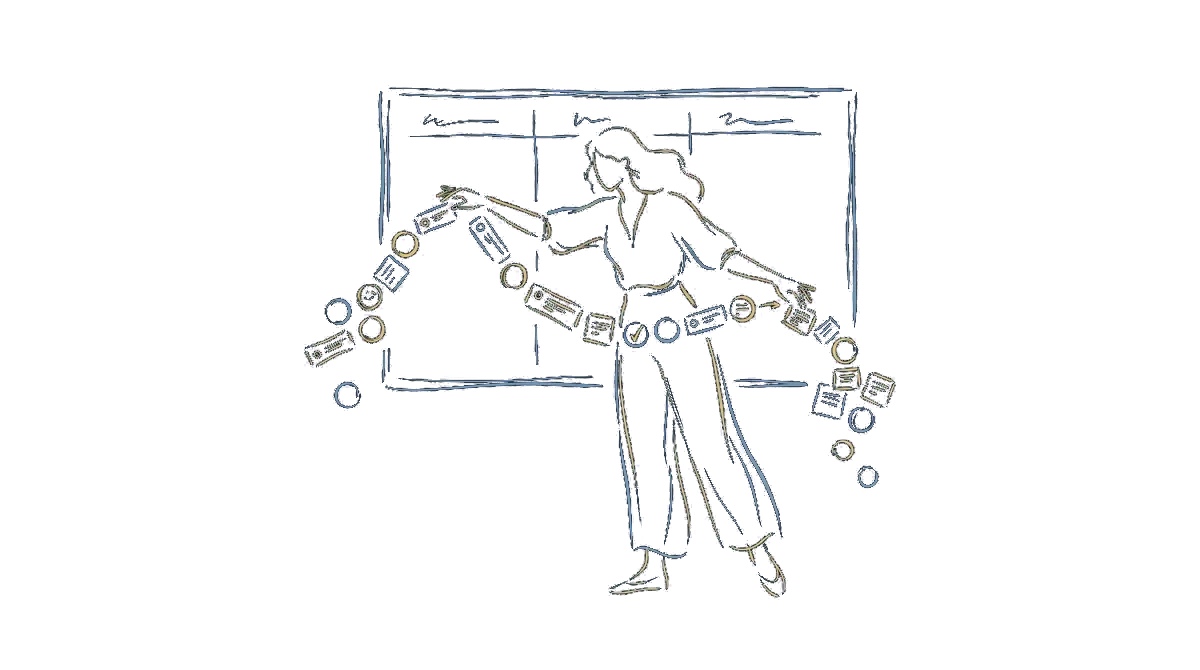
This training course is designed for:
The executive who paid for the licenses
Their teams have had access to AI for months, and the executive still can't say how the work itself has changed.
The manager who has to decide
They have to name the tasks that move to the tool and those that stay under the responsibility of someone in their department.
The HR director who plans ahead
She sees the questions about job descriptions, skills and workload coming and wants to deal with them before they escalate.
Plan AI integration across your teams with the STEP method
Learning objectives
The learning objectives of this training course can be assessed. By the end of the session, each participant is able to:
- Describe the 4 stages of Paul Leonardi's STEP method (segment the tasks, evolve the roles, keep learning, evaluate differently) and explain the order in which they follow one another
- Build an inventory of the actual activities in their area from their own organizational documents, bringing implicit tasks to light
- Segment each inventoried activity into automation, augmentation or direct human responsibility, justifying each classification against a criteria grid
- Redesign 2 processes in their area by setting out, at each step, the actor, the input data, the human checkpoint and the acceptance criterion for the deliverable
- Identify the effects of transferring tasks on their team's roles, skills, workload and responsibilities
- Build an upskilling plan by role and choose 3 to 5 observable tracking indicators, each with a baseline value and a review date
- Draw up a phased 30-day rollout plan with a clearly scoped first batch, a dated sequence and checkpoints
- Identify the confidentiality and data governance issues raised by using generative AI on the company's internal processes
Audience and prerequisites
Target audience. Leaders of small businesses and SMBs (owners, presidents, CEOs) who are considering bringing generative AI into their teams' work. Managers and department heads responsible for an area of activity and for organizing the work of several employees. Operations directors, HR directors and transformation leads who need to scope an AI rollout across a whole division.
Prerequisites. No programming or technical prerequisites. The course assumes that the trainee manages a team or runs an area of activity they know and can describe, since all the exercises are based on their own work processes. Experience managing a team or running an area of activity. Enough knowledge of their department's processes to describe them step by step. Comfort with everyday digital tools (web browser, office suite, email, file manager).
Each participant's actual level is checked before the session with a placement questionnaire, which is used to adjust the course outline.
Program
The full outline, sequence by sequence, is in the detailed program you receive before registering.
Want this training for your team?
Answer 3 questions and your estimate appears. We call you back within 48 hours with the quote, the detailed program and possible dates.
Teaching methods and resources
The course alternates between live demonstrations with commentary, guided workshops and hands-on practice on the participants' real cases. Theory is limited to what you need to put things into practice.
- A practitioner trainer who works on the topics taught
- Course materials provided to each participant
- Each participant works on their own computer with their own files
- Environment set up in advance and tested before the session
In person
The training takes place at the client's premises. The client provides a room equipped with a projector or screen, an internet connection and one computer per participant.
Remote
The training takes place in a virtual classroom, as a group and live with the trainer, at set times. Participants interact by voice, screen sharing and chat, in both directions and throughout the session. Each participant's login is recorded and serves as proof of attendance. Technical support is available by email and phone for the whole session, and a connection test is offered before the day.
Hybrid
A single session can bring together on-site and remote participants. The trainer leads from the in-person venue, and remote participants follow in a virtual classroom with the same individual support and the same deliverables.
Assessment and certification
- Placement questionnaire before the training starts
- Continuous assessment through the exercises produced during the session
- Final assessment of what was learned against the objectives listed above
- Satisfaction survey at the end of the session, then a follow-up survey a few weeks later
Each participant receives an end-of-training certificate stating the objectives and the assessment results. A certificate of completion is also sent to the funding body where applicable.

Official title in the training program: “Penser l'intégration de l'IA dans ses équipes avec la méthode STEP de Paul Leonardi : segmenter les activités avant d'automatiser” (Planning AI integration across your teams with Paul Leonardi's STEP method: segment activities before automating). Page updated on August 31, 2026.

Free course to get started with Claude
Judge our teaching before you commit a budget.
- 1 hour 20 minutes of video in 5 short modules
- Installing Claude and setting up your workspace
- 6 ready-to-copy skills and starter files
- The privacy settings to apply from your first day
- A selection of 20 AI tools for marketing
The course videos and emails are in French.
Any questions?
Accessibility · results · complaints
Our quality commitments, our results indicators and the adjustments available to people with disabilities are published on a dedicated page.