In 2026, Metricool, Buffer and Publer published their “Claude” page (Metricool, Buffer, Publer), and Hootsuite and Agorapulse their MCP server. Each one explains how to connect Claude to its tool. Once Claude is connected, a marketing team asks 2 questions: how does Claude write in the brand's voice, week after week, and who does what?
This guide starts from what I use. My LinkedIn posts have gone through a studio of agents in Claude since June 2026, and since November 23, the comments on the pages of a local mutual health insurer have been moderated by a workflow where AI suggests and I publish. I'll show you my setup, the publishing tool I recommend, Zernio, and a sourced comparison with Agorapulse, Hootsuite and 5 other tools.
Community management with AI agents
A chat answers a request. An AI agent receives a goal, reads its instructions and acts in your tools until it gets the result. For community management, the difference shows over time: a chat forgets your tone by the next conversation, and an agent rereads it at every task.
In practice, Claude can now find your topics for the week, write a post, produce its visual, schedule it, read the comments, suggest a reply and review the month. Every move that commits the brand in public stays yours. The job changes shape: the community manager hands off first drafts and keeps their time for decisions, relationships and the kit that guides the agents.
I describe 10 agents in service in 10 AI agents that work on my marketing, 5 of them for social media.
The brand brain Claude rereads before every post
Without precise instructions, a language model writes the most likely continuation, which means the average of what it has read. Your readers spot it in one line. The brand brain corrects that tendency: a folder of files that Claude reads before writing, and that grows with every correction.
| File | What it contains | What it's for |
|---|---|---|
| The editorial guidelines | Positioning, pillars, register, formal or informal address | Every text |
| The blacklist | Banned words and phrasings, including the tics of generated text | The automated checks |
| The approved examples | Your best posts, with their numbers | The voice, by imitation |
| The moderation kit | The comment situations, with the action and template reply for each one | Public replies |
| The visual tokens | Colors, fonts, logos | Visuals and their checks |
| The corrections log | The edits you've made, written down so you never have to make them again | Everything produced afterward |
The CLAUDE.md file, at the root of the folder, tells Claude where to find each piece and what it never does. Skills, procedures Claude applies on demand, draw on these files for every piece of output. I've detailed the 4-layer method in brand guidelines that Claude can read, and how to make this context last from one project to the next in the agency memory Claude rereads at every task.
Set up your brand brain in one workshop
5 video modules and a 7-step kit, in Claude: your guidelines, your tone and your refusals stored in files that Claude rereads before every piece of output.
See the workshopWorkshops and the community run in French.
Organizing your community management with agents
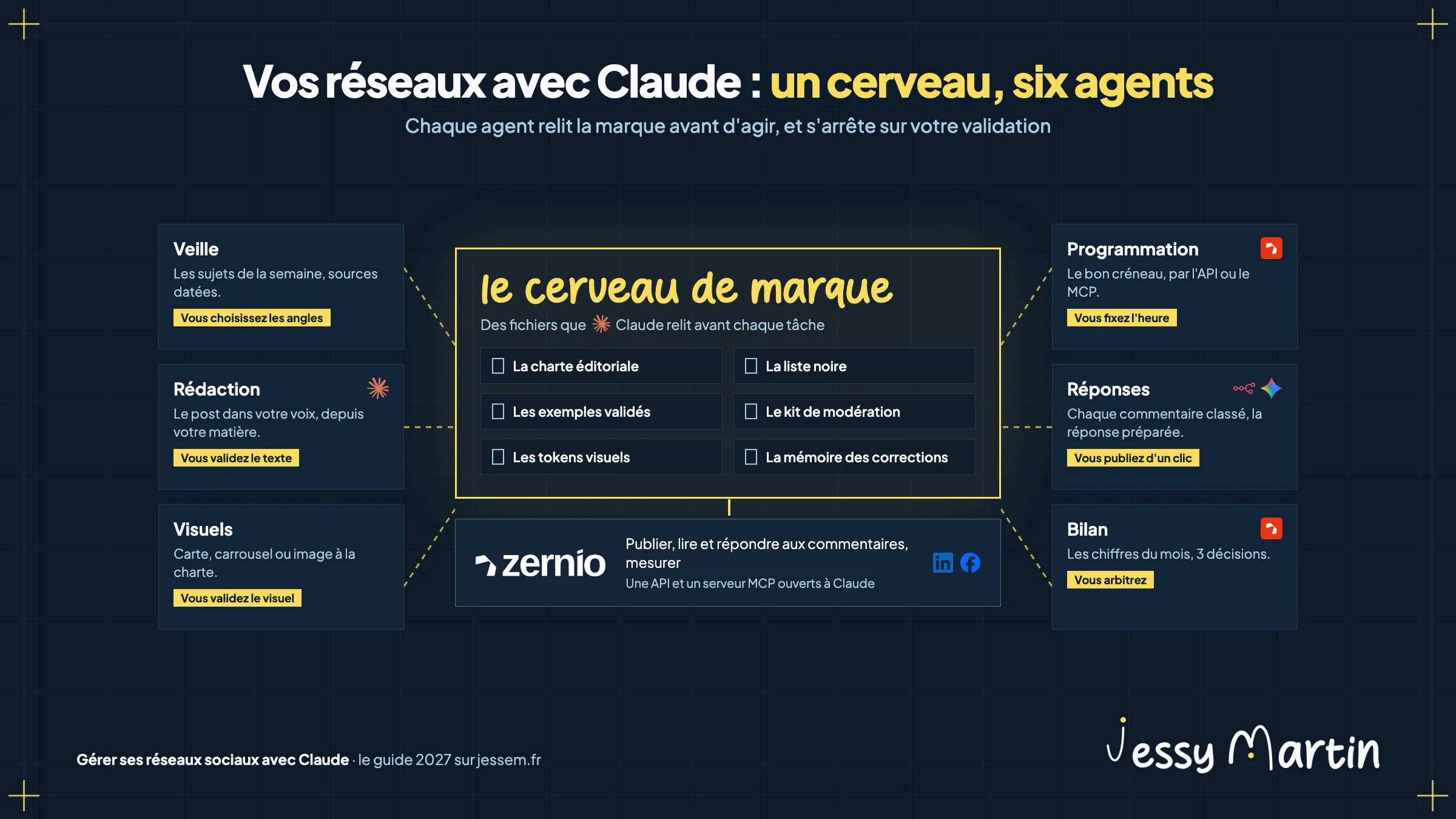
I split the work among specialized agents, which all read the same brand brain. Each one has a narrow mission, easy to review and correct, and stops at the same place: your approval.
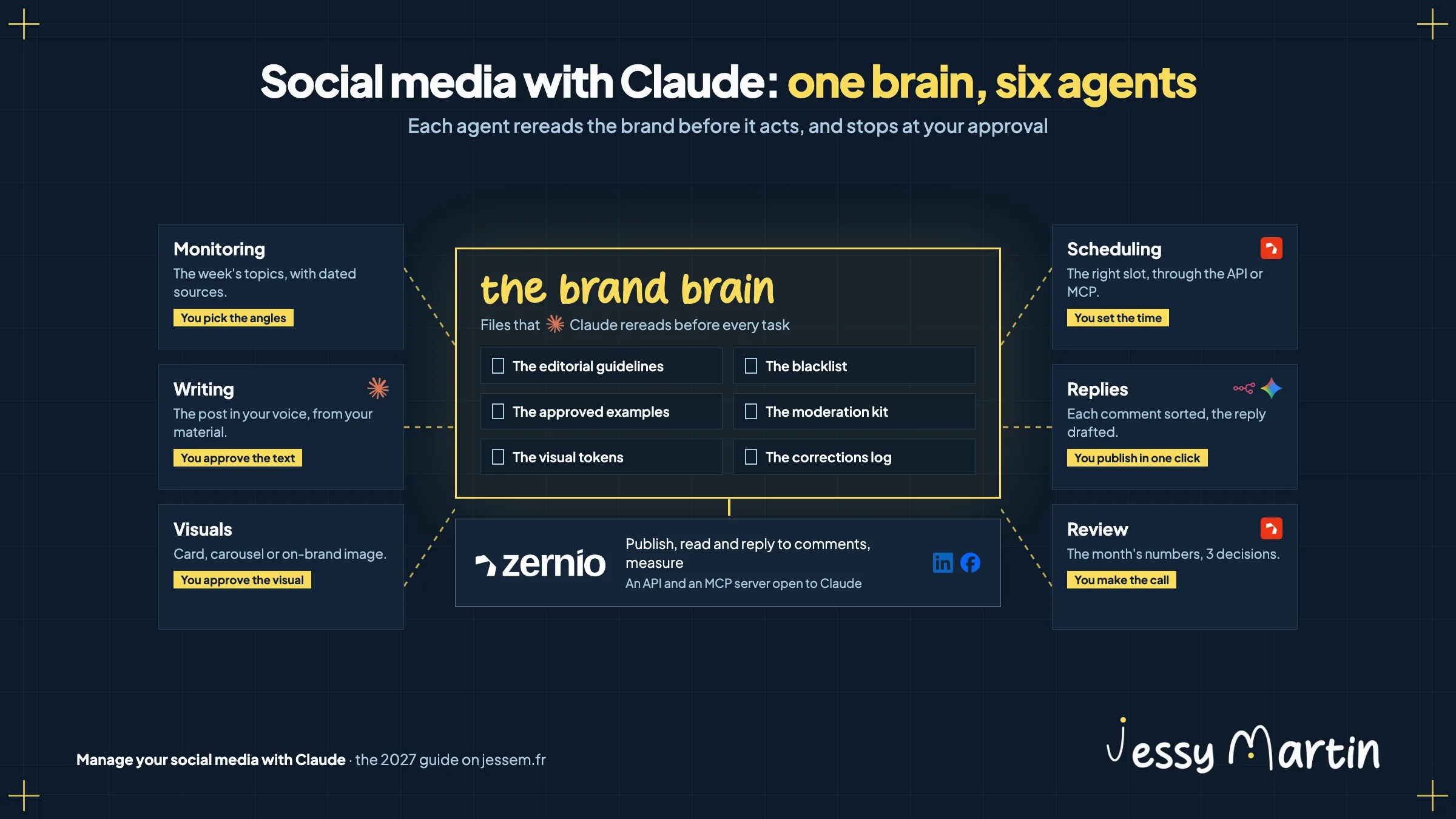
| Agent | What it does | When | What you approve |
|---|---|---|---|
| Monitoring | Spots news and topics in your industry, with dated sources | Every week | The chosen angles |
| Writing | Writes the post in your voice, from your material | Before each post | The final text |
| Visuals | Produces an on-brand card, carousel or image | Depending on the post | The visual |
| Scheduling | Schedules the post in the right slot, through the tool's API | After approval | The date and time |
| Replies | Sorts each comment and drafts the reply | With every comment | Each published reply |
| Review | Reads the month's results and suggests 3 decisions | Every month | The adjustments |
My content studio follows this split. As of October 28, 2026, its log counted 448 pieces of output, including 55 for 38 distinct LinkedIn posts. The free template I built from it is detailed in the agent that writes your LinkedIn posts. Monitoring can run as a scheduled routine, as I explain in automating your marketing monitoring with Claude and in a scheduled routine with Claude.
A typical week comes down to 3 check-ins. On Monday, you pick 2 or 3 angles from the monitoring. Before each post, you give your material to the writing agent and approve the text, visual and slot in one go. Through the week, you review the replies to comments from your inbox.
Replying to comments is the most sensitive part
A post gets reviewed before it's published. A reply to a comment often goes out in a rush, in the brand's name, in front of everyone. That's where AI helps most and where it needs the tightest rein.
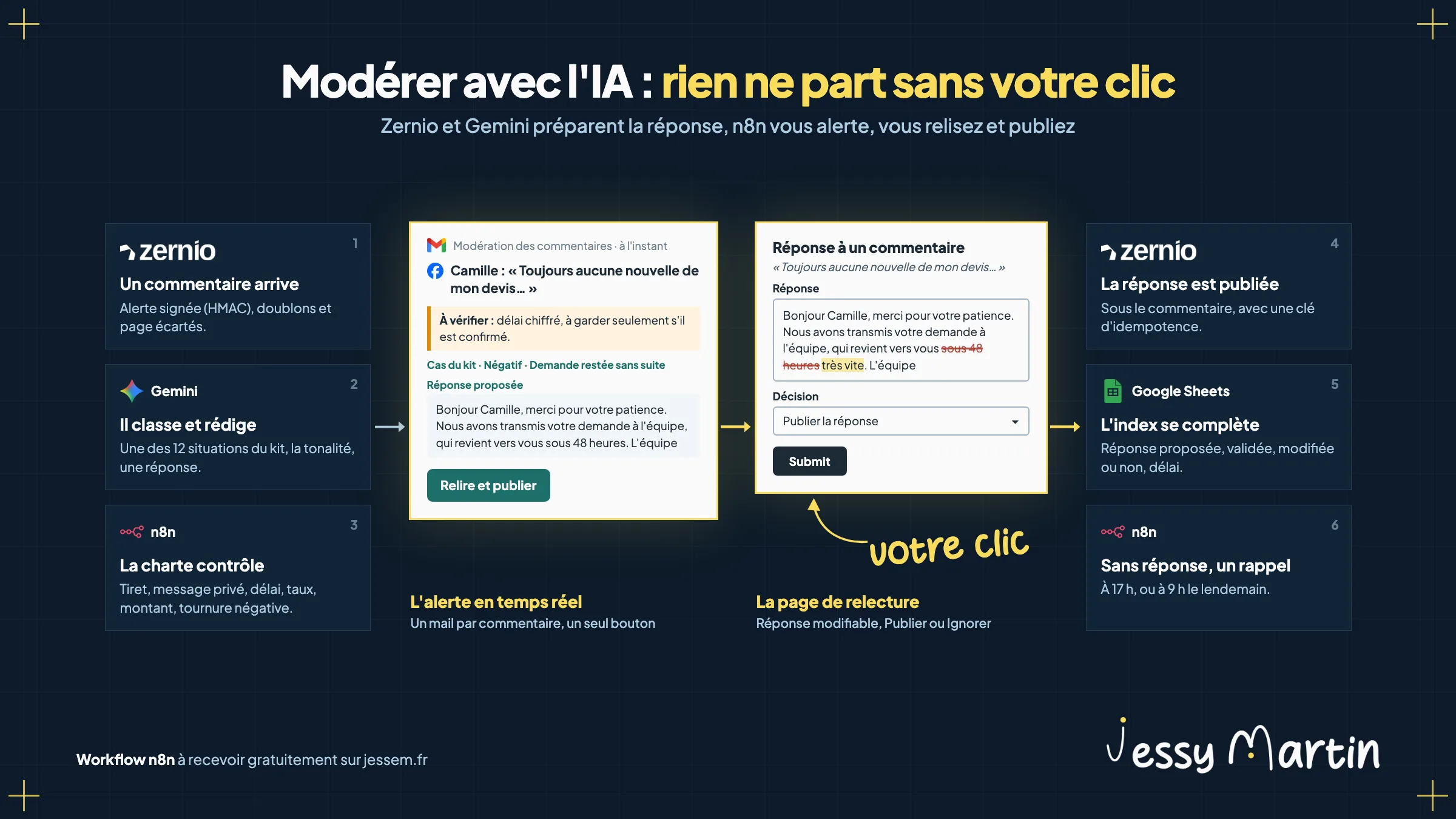
My workflow receives each comment through Zernio, has Gemini sort it and draft a reply from the moderation kit, checks the reply, then sends me an email with a review page: a human approves each reply with one click. All the mechanics, the guardrails and the downloadable workflow are in replying to comments with AI. The same circuit works with Claude in place of Gemini: only the model node changes.
The comments and their authors' names then go through the model, like the messages Claude reads through an MCP server. These are personal data: record the processing in your register and choose a plan that excludes training on your data. I detail these habits in GDPR and the AI Act applied to customer data.
Zernio is the publishing tool open to agents
For an agent to publish, read comments and reply to them, it needs a tool that allows it. That's Zernio's role. The company used to be called Late: the old getlate.dev address redirects to zernio.com, and its documentation still uses the old webhook signature header (webhook documentation). Founded in 2025 in Girona, Spain, it has 9 people and funds itself (Zernio's About page).
What Zernio can do, as noted from its documentation on November 23, 2026:
- Publish and schedule on the main networks, including LinkedIn (profiles and pages), Facebook, Instagram, TikTok, YouTube, Threads, X, Pinterest and Bluesky (platform comparison). The first comment is advertised on every account (Zernio's pricing) and documented for Facebook and Threads.
- Read and reply to comments through the API, hide them, and reply by private message on Facebook and Instagram. The API also accepts posts published outside Zernio (comments API).
- Alert in real time with a signed webhook for each comment, carrying a stable event ID to filter out duplicates (webhooks).
- Avoid duplicates with idempotency keys, on posts and replies alike: an agent that retries after an outage doesn't publish twice (API reference).
- Measure impressions, reach, reactions and clicks, and suggest the best time to post (limits and advanced analytics).
- Connect to Claude through a hosted MCP server, with an “Add to Claude” button and a plugin for Claude Code. Through it, Claude reaches posts, comments, messages and analytics; in ChatGPT, the same server is limited to posts and analytics (MCP documentation). An n8n node and a Zapier integration round out the set.
Pricing is per connected account, with unlimited users: the first 2 accounts are free, then $6 per account per month up to 10 accounts, or $48 for 10 accounts (Zernio's pricing).
Why Zernio could become the standard for teams that run on Claude
I'm making a bet: the community management tool that wins will be the one that opens the whole loop to the agent. Today, Zernio opens it the widest, and at the lowest price for that level of openness. Publishing, reading, replying, hiding, getting alerted: at Zernio, everything goes through the same API, included on every account, free ones included.
Among the leaders, the same loop is closed in places. Sprout Social's API is reserved for its Advanced plan and reads messages without being able to reply to them (Sprout API documentation). Buffer's covers neither comments nor webhooks. Metricool's MCP leaves out the inbox. Agorapulse opens a reporting API on its Custom plan (sources in the comparison below).
I have 3 reservations. The leaders are catching up fast: Hootsuite offers 4 official MCP servers, including one for the inbox, and Agorapulse launched its own on October 29, 2026. Zernio is built for developers: a team that wants a shared calendar, multi-level approval workflows, social listening and ready-to-send reports will find them at Hootsuite or Agorapulse. Finally, Zernio has no built-in AI: all the judgment rests on the agent and on your brand brain. For a team that knows Claude well, that's a strength. For a team new to AI, it's a step up.
Zernio vs Agorapulse vs Hootsuite and 5 other tools
Entry price, comment inbox, API, MCP and built-in AI, as noted on November 23, 2026 from each vendor's official pages. Prices in dollars or in euros excl. VAT, as displayed, billed annually unless stated otherwise.
| Tool | Entry price | Comments | Public API | MCP and agents | Built-in AI |
|---|---|---|---|---|---|
| Zernio | 2 free accounts, then $6 per account per month (no annual commitment) | Read, reply, hide, through the API and MCP | Complete, on every account, with webhooks | Hosted MCP: posts, comments, messages, analytics | None, the AI comes from the agent |
| Agorapulse | $79 per user, 10 profiles | Inbox from Standard | Reports only, Custom plan | MCP launched on October 29, 2026, replies confirmed by the user | Writing; suggested replies on Custom |
| Hootsuite | $99 per user, 10 accounts | Inbox from Standard, AI replies from Professional | Yes, subject to approval, with webhooks | 4 MCP servers, including the inbox | Wisdom agent, smart replies |
| Sprout Social | $79 per seat, 5 profiles | Inbox from Standard ($199) | Advanced plan ($399), reads messages without replying | MCP for ChatGPT, TikTok data, read-only | Trellis agent, sentiment |
| Buffer | Free, then $5 per channel | Inbox on every plan | Yes, without comments or webhooks | MCP: posts and analytics, without comments | AI assistant, AI replies |
| Metricool | €16 per month | Inbox from the free plan | Advanced plan (€43) | MCP without the inbox | Credit-based AI assistant |
| Swello | €19 excl. VAT per month | Replies to comments; private messages coming soon | Not found | Not found | Writing help |
| Later | $18.75 per month | From Growth ($37.50) | Not found | Not found | Caption writing |
“Not found” means that none of the official pages I consulted mentions it. The market moves every month: I'll update this table in January 2027.
Which tool to choose for your team
Your team already runs its content with Claude. Zernio, connected through MCP for day-to-day work and through the API for automations such as comment moderation. You pay for the accounts, and your agents do the rest.
Your team wants a complete interface, with multi-level approval and social listening. Agorapulse or Hootsuite. Their recent MCP servers already let Claude read the inbox and prepare replies.
You work alone, on a small budget. Metricool or Swello cover scheduling and the inbox for around €20 a month. The day you want agents, Zernio costs less than the next tier of these tools.
Where to start
Start with the brand brain, before any tool: without it, every agent will write the average. Then connect Zernio to Claude through its MCP, and have it schedule a first post that you've approved. Add one agent at a time, keeping approval in the same place. When comments become a burden, install the moderation workflow. If n8n feels intimidating, Claude can build the automation for you: I show how in building an n8n workflow with Claude.
If you want to scope this project with your team, the AI maturity assessment gives you a first snapshot (the report is in French).
Which community management task would you hand to an agent first?