n8n looks intimidating at first glance: nodes to connect, expressions in curly braces, credentials to configure, cryptic technical error messages. Many marketing teams stop there, which is a pity, because the tool is free when self-hosted and connects to just about everything an SMB uses.
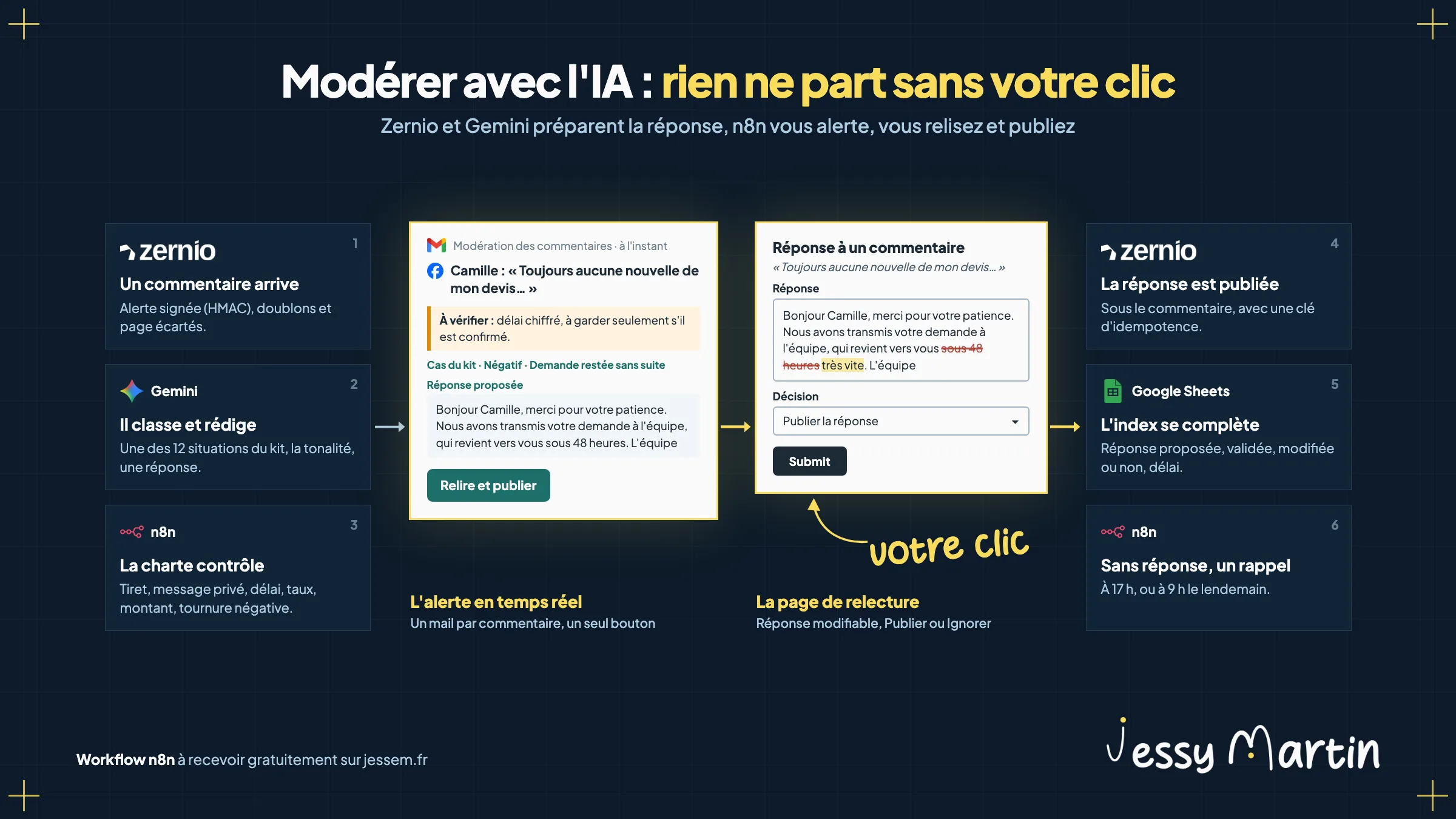
Claude can now build an n8n workflow for you: it knows the nodes, writes the expressions, creates the workflow on your instance and tests it. Your job becomes describing the need and approving. That's how I set up the workflow from my article on replying to comments with AI, along with most of the automations that run my training provider [an organization registered with the French State to deliver vocational training].
What Claude does for you in n8n
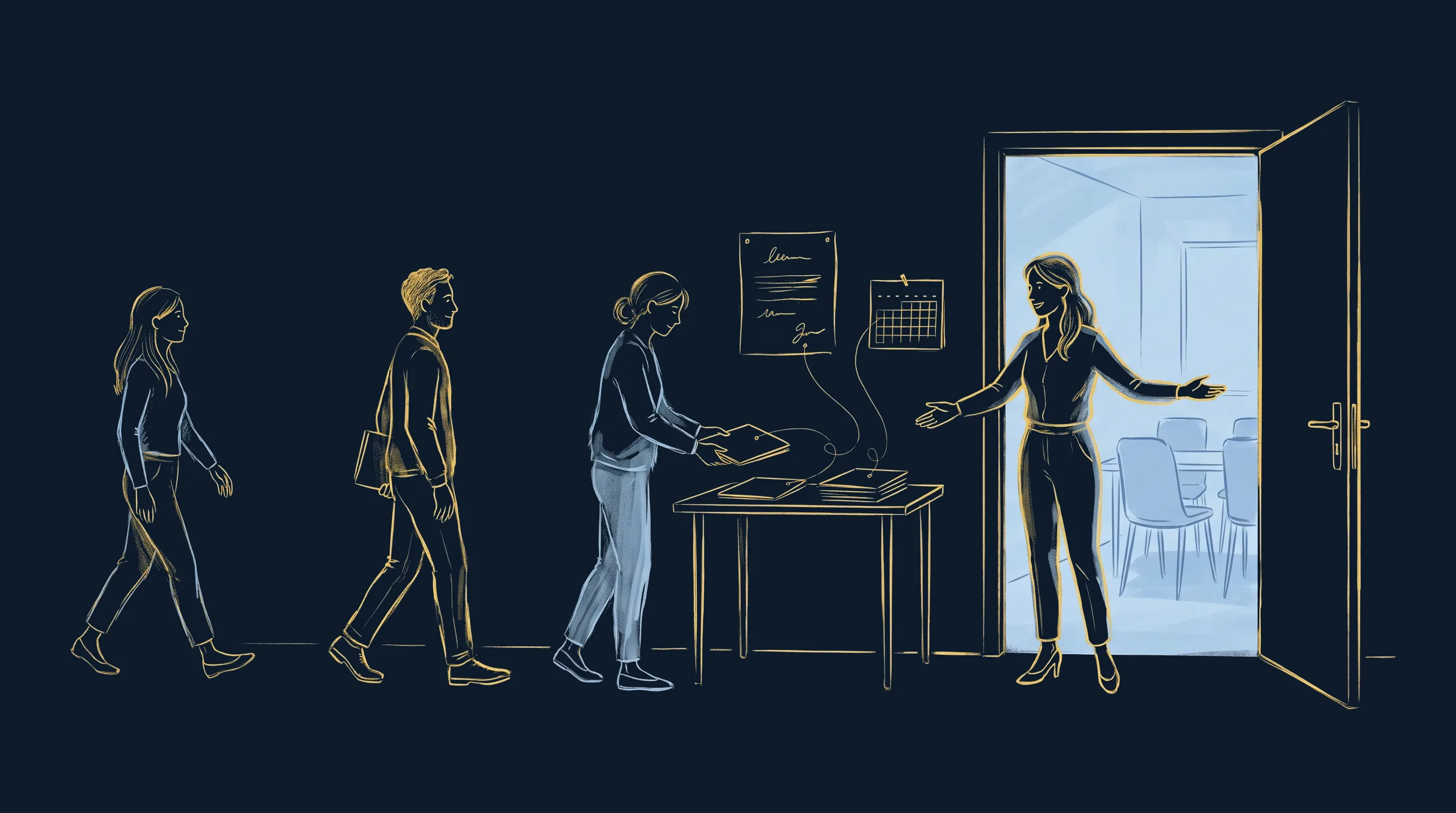
You describe the need in plain words: “every signed quote dropped in the Drive should go online, with an email to the sales team.” Claude looks for comparable workflows, proposes an architecture and waits for your go-ahead. Then it picks the nodes, sets their parameters, writes the code for the Code nodes, wires up error handling, creates the workflow on your instance, runs it with test data and fixes whatever breaks.
It also reads the execution logs. When a live workflow fails at 3 a.m., you give it the execution ID, it finds the faulty node and suggests the fix. That's often where the gain is clearest: an n8n error message is hard to make sense of when you've never seen one.
Connect Claude to n8n: 2 ways
Claude acts on n8n through MCP, the protocol that connects an AI assistant to tools. 2 servers exist, and both can create and edit workflows.
| n8n-mcp (open source) | n8n's official MCP | |
|---|---|---|
| Publisher | Open-source project by czlonkowski on GitHub, MIT license | n8n, built into the instance, which has been able to create and edit workflows since version 2.13.0 |
| What it brings | Documentation for 3,501 nodes, validation, creation and updating of workflows through the n8n API | Node search, validation, creation, testing and publishing of workflows, on the instance itself |
| With Claude | Local server in Claude Code, or hosted service | Connector published by n8n in Claude's directory (27 tools), or a server added to Claude Code |
| The skills | n8n-skills, 14 procedures (expressions, Code nodes, error handling, AI agents…) | n8n-io/skills, the official procedures from the n8n team |
Checked on November 23, 2026: n8n-mcp is at version 2.103.2. The skills, procedures that Claude loads when it needs them, matter as much as the server: they teach it the expression syntax and the pitfalls of each node, which saves most of the back-and-forth.
Connectors added in the Claude app connect from Anthropic's servers (Claude's help page on connectors). So an n8n installed on your machine, on localhost, stays invisible to them. 2 solutions: Claude Code, which runs the MCP server on your computer, or an n8n instance reachable over HTTPS, like mine, self-hosted on a small server.
n8n also offers its own built-in assistant, the AI Assistant, which builds and troubleshoots workflows from the interface. n8n had built its workflow builder on Claude, and this assistant replaces it (n8n's customer story at Anthropic). It uses credits depending on the plan. I prefer Claude Code: it keeps my method and my conventions from one workflow to the next, in files I control.
The 4-step method from advice to build
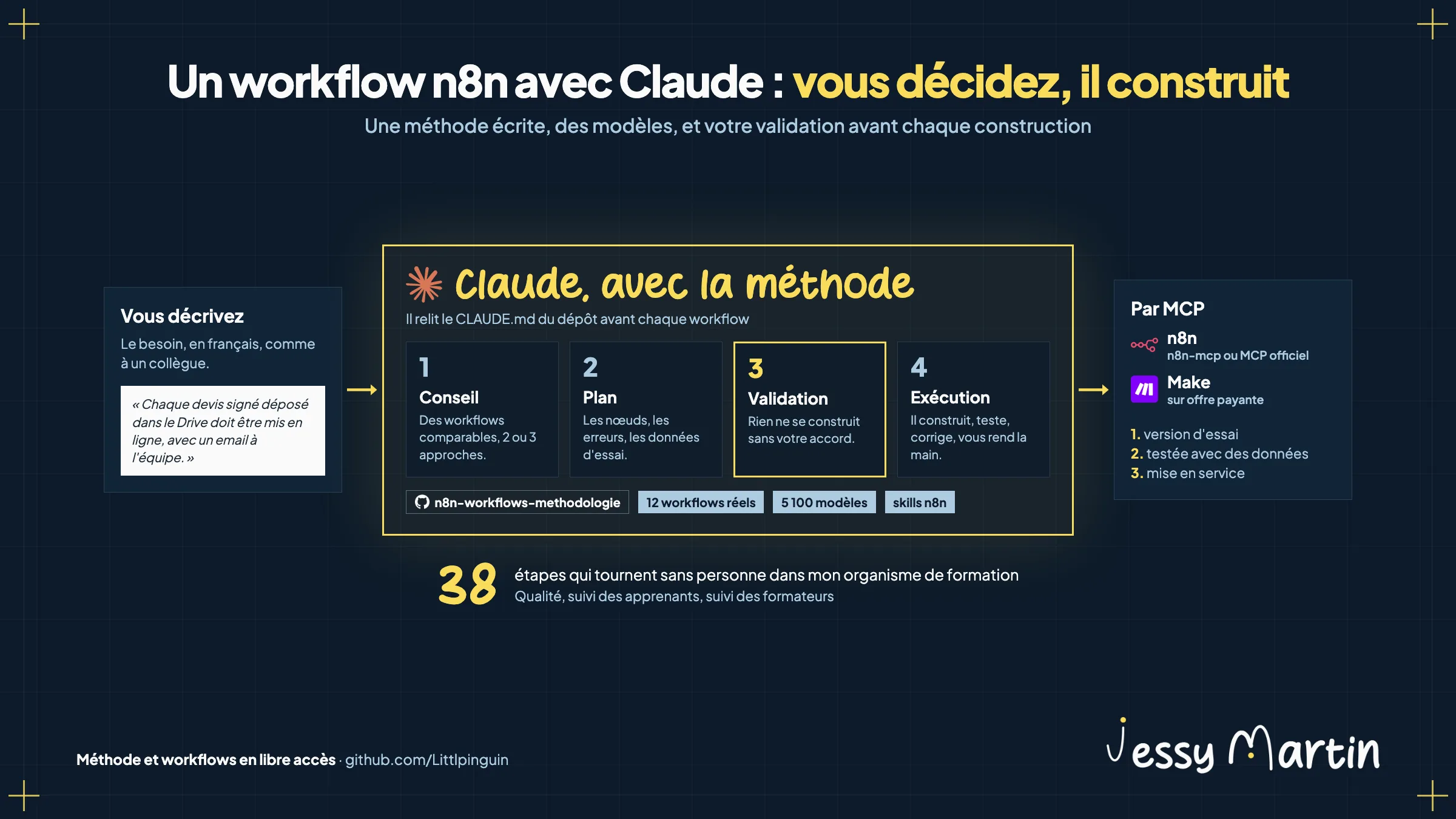
An assistant that builds fast also builds the wrong thing fast. My method has 4 steps, written in the CLAUDE.md file that Claude rereads every session:
- Advice: Claude restates the need, looks for comparable workflows in the template libraries and proposes 2 or 3 approaches.
- Plan: it describes the chosen architecture, node by node, with error handling and test data.
- Approval: nothing gets built until you approve the plan.
- Build: it builds, tests on the instance, checks the workflow's state, then hands control back to you.
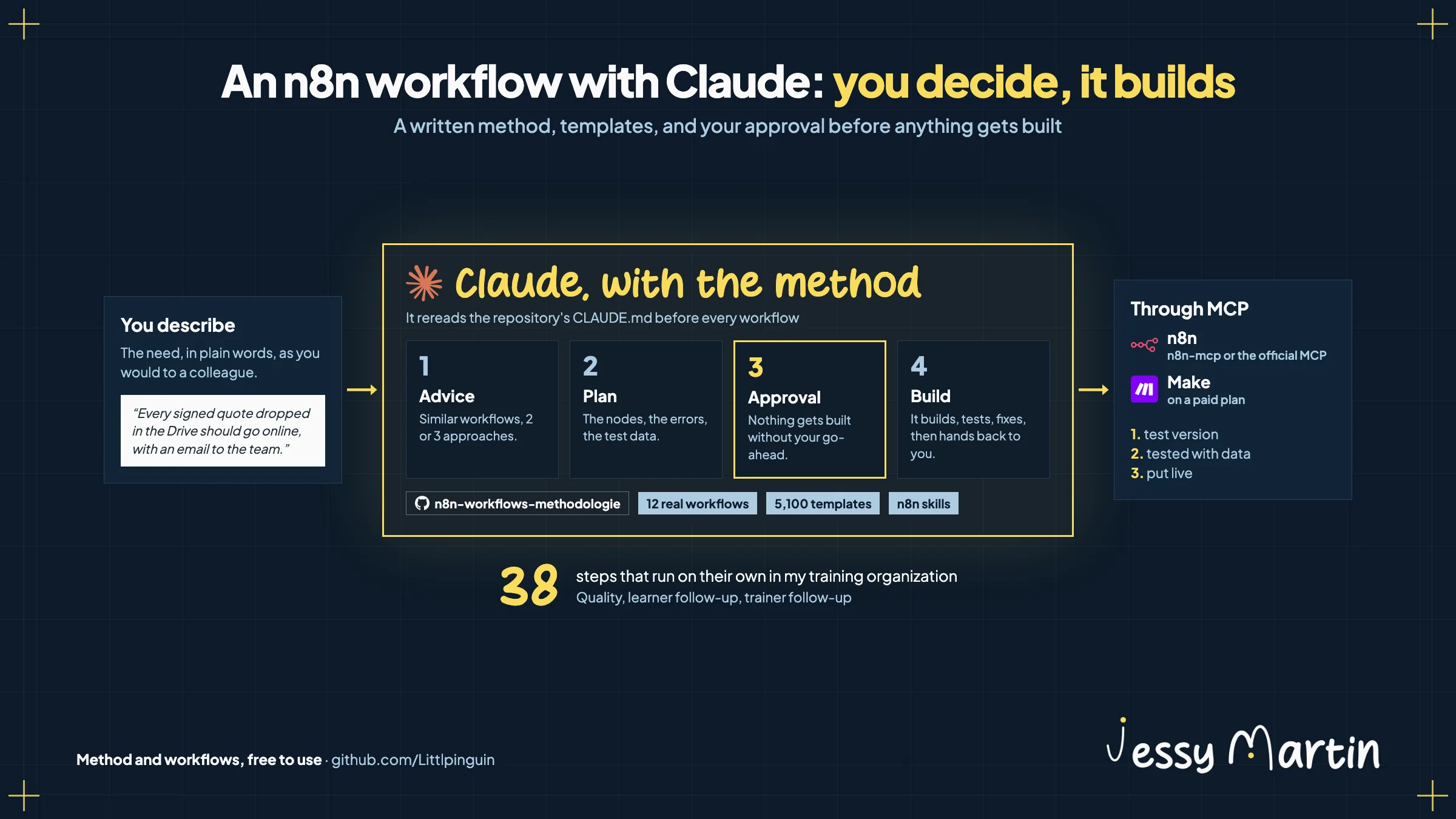
I add 2 rules that come from production. An active workflow is never edited live: Claude keeps a copy, works on a test version with a separate webhook path, tests, then replaces the live version. The author of n8n-mcp gives the same advice, because the server rewrites the whole workflow and can overwrite a change made in the interface while the agent is working. And secrets stay out of workflows: keys live in n8n's credentials or in environment variables.
For the workflows that matter, I go further: Claude writes a small program that generates the workflow, the logic file and its tests. The comment moderation workflow is built this way. Its logic is tested outside n8n, then the program sends it to the instance inactive, connects the neighboring tool and runs a test that publishes nothing. The day it needs a change, Claude edits the program and reruns the tests: the workflow rebuilds identically.
The repository: my method plus 12 workflows and 5,100 templates
I've published the anonymized version of my automation repository under the MIT license: Littlpinguin/n8n-workflows-methodologie (in French). You open it in Claude Code, Claude reads the method, and you're ready to start.
| Folder | What it contains |
|---|---|
CLAUDE.md | The method: architecture, naming, error handling, quality checklist, expression reference |
workflows/ | 12 real workflows in JSON: inbox sorting, FAQ drawn from emails, WordPress publishing, lead generation, résumé screening, meeting summaries, monitoring, newsletter, error handler… |
docs/ | 17 implementation plans, the design specs, and the log of what broke in production and why |
| 3 submodules | More than 5,100 reference workflows published by other authors, which Claude browses during the advice step |
git clone --recurse-submodules https://github.com/Littlpinguin/n8n-workflows-methodologie.git
cd n8n-workflows-methodologie
claude
The workflows won't run as they are: credentials and resources are replaced with placeholders that you swap for your own. The incident log, in docs/, is probably the most useful part: workflow by workflow, it records the errors encountered and how they were fixed. Claude uses it to avoid repeating them. The 3 template libraries remain under their authors' licenses, which you should check before any reuse.
My use cases: a training provider that runs itself
My process map for Jessy Martin Academy has 118 steps, from qualifying a trainer to archiving the proof. As of November 20, 2026, 38 of them trigger with no one involved: 10 scheduled tasks, mostly in n8n, and 28 steps that react to an event or a time of day, in the platform code that Claude also wrote, in Claude tasks or in Google Meet. 30 others are human actions: signing, running sessions, approving. The last 50 are in testing or under construction.
The quality process. Every email goes out with its entry in the log, proof of delivery included. Closed attendance sheets go to the Drive, and the video call attendance report is pulled 6 hours after each session. On the 28th of each month, a Claude task checks the dated facts in the training materials; on the 1st, a second task produces the Qualiopi [France's quality certification for training providers] monitoring note. The data is backed up every Sunday.
Learner follow-up. Invitations go out on the hourly run, then are resent once a day, with a fresh link, until the account exists. A daily reminder at 9 a.m. flags the documents still to sign, then the placement test to take. Each session triggers a reminder the day before and one hour before. The delayed satisfaction survey opens at 60 days, with a reminder 3 days later.
Trainer follow-up. Once the engagement letter is accepted, n8n makes the trainer co-host of the video call. The pre-session procedures appear in their space 7 days ahead. If their attendance sheet is still open 15 minutes after the session ends, a reminder goes out. At the last session, the skills assessment grid arrives prefilled, and all they have to do is approve it.
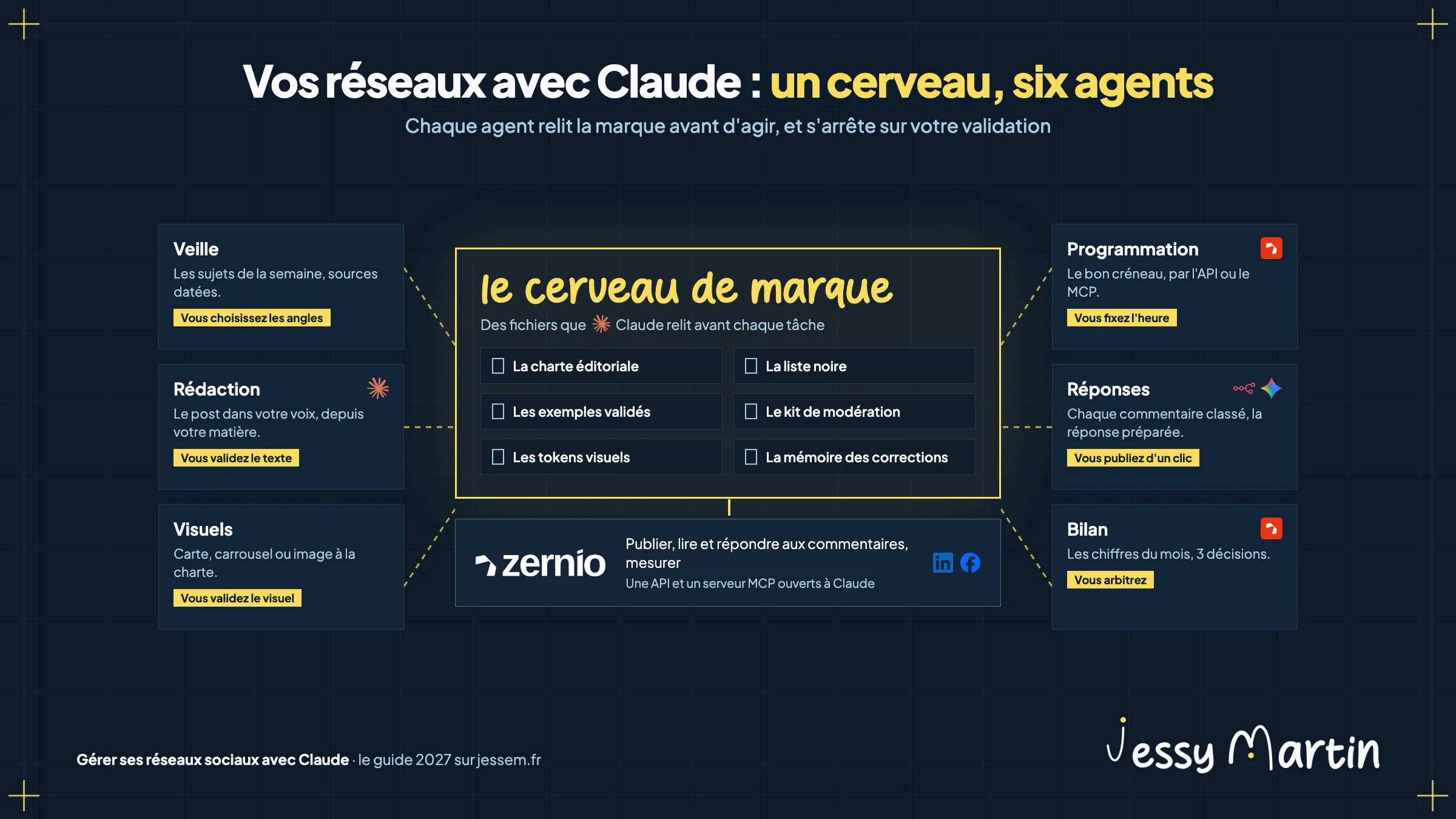
I've described the complete chain, with the cost and a comparison with the software on the market, in automating your training provider business with Claude Code. On the sales side, the same method publishes the training proposals dropped into a Drive folder, which is polled every 10 minutes. Outside the training business, it moderates a client's social media comments, as I describe in my guide to managing your social media with Claude.
The same thing with Make
Make follows the same path. Its official MCP server connects to Claude from the connector directory (Make lists 67 tools there) or with a command in Claude Code:
claude mcp add --transport http make https://mcp.make.com/claudeThe difference comes down to the plan. On Make Free, Claude can only run the scenarios you've set to be called on demand. On a paid plan, it can also list, create, edit, activate and deactivate scenarios, and manage connections and data stores (Make's help page on its MCP server). Make also publishes Make Skills, in open beta, which teach Claude to build a scenario from a description, and offers Maia, its built-in assistant.
Make and the author of n8n-mcp give the same advice: work in a test team or instance, since the agent acts on the real account. On Make's forum, a user reports that scenarios generated by Claude didn't work on the first try (thread on Make's forum): testing remains your job.
n8n or Make: which one to choose
| n8n | Make | |
|---|---|---|
| Entry price | Free when self-hosted; n8n Cloud from €24 per month (€20 billed annually), 2,500 executions | 1,000 free credits per month; Core plan at $9 per month for 10,000 credits, according to Make's comparison page |
| Billing unit | One complete workflow execution | One credit per action, in most cases |
| Claude creates the automations | On every plan, self-hosted included | On paid plans |
| Hosting | With n8n or on your own server | With Make |
Checked on November 23, 2026. The self-hosted version of n8n is free under the Sustainable Use License, which covers a company's internal use; reselling n8n as a service requires an agreement with the vendor. I work with self-hosted n8n for that reason, and because my data stays on my server. If your team already uses Make, keep it: Claude connects to it too, with a paid plan to build.
Precautions to take
An agent that creates automations acts on real tools, with your access. Keep a test instance or team for the first trials, approve every plan before the build, and review what a workflow sends outside your organization. Workflows that pass customer data through an AI model fall under the GDPR: record the processing in your register and choose plans that exclude training on your data (I lay out the habits in GDPR and the AI Act applied to customer data). To set rules that Claude can't get around, such as a ban on touching a live workflow, Claude Code hooks do the job.
Where to start
Pick a repetitive task that costs you an hour a week and doesn't touch customers yet: a report to compile, files to organize, an internal follow-up email. Open the repository in Claude Code, describe the task, and let Claude handle the advice and the plan. Your first workflow will teach you n8n from the inside: Claude explains every node it adds.
Which task would you hand over to an automation first?