In October, I designed 2 courses on marketing with Claude, one for opticians, the other for bakeries. For bakery employees, I was counting on €40 an hour from OPCO EP [the OPCO for local businesses and skilled trades].
Its 2026 grid reserves that amount for in-person training. My course runs remotely.
Funding AI training through an OPCO or a business owner fund comes down to these details: a status, an industry, a format and a filing date. I reread each official grid on October 28, 2026, and every amount in this article comes from them. The grids and government pages I link to are in French.
Who can fund AI training for you depending on your status
The funder depends on the person being trained. In the same store, the manager and the salaried sales assistant knock on 2 different doors.
| Your status | Who funds | Where to check |
|---|---|---|
| Employee | The OPCO of the employer's industry | The IDCC [the number of a French collective agreement] the employer declares |
| Self-employed head of a retail business: majority manager of a SARL [a French limited liability company], sole partner of an EURL [its single-member form], sole proprietor or micro-entrepreneur [France's simplified self-employed status] | AGEFICE | The training contribution certificate issued by URSSAF [the French agency that collects social contributions] |
| Self-employed craftsperson, their collaborating spouse, their partner spouse or a family member who works without pay | FAFCEA | The URSSAF certificate and the craft activity code |
| Self-employed professional, such as a consultant or a lawyer | FIF PL [the training fund for self-employed professionals] | The URSSAF payment certificate, which must bear their name |
| President of an SAS or SASU [French simplified joint-stock companies, the second with a single shareholder], minority manager of a SARL | No business owner fund | The CPF for a certification, otherwise the company's budget |
| Anyone in work | CPF | A course that prepares for a registered certification |
For a business owner, URSSAF settles the question. AGEFICE funds the business owners that URSSAF assigns to it, and FIF PL asks you to check that your name appears on the payment certificate.
The president of an SAS or SASU has no business owner fund. FAFCEA and AGEFICE both exclude them, and OPCO EP rules out anyone without an employment contract. The tax credit for business owner training ended for courses completed after December 31, 2024, according to Entreprendre Service Public [the French government's portal for businesses].
AI training funding is calculated by the hour
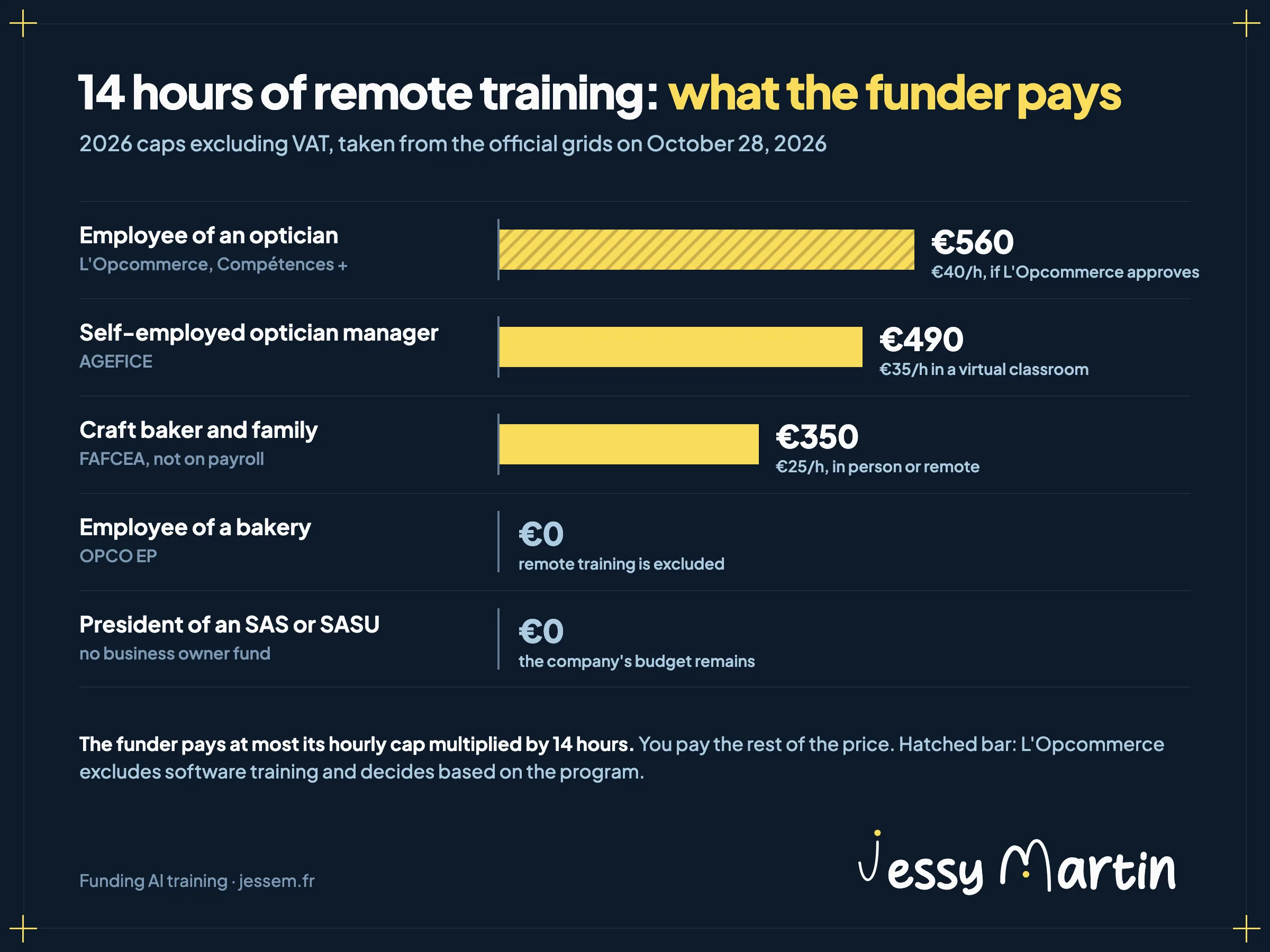
The 4 funders in this article all work the same way: an hourly cap, multiplied by the length of the course, within an annual limit in euros or in hours. At €40 an hour, 14 hours come to €560 at most. You pay the rest of the price.
The format changes the cap. AGEFICE caps in-person training at €42 an hour and virtual classroom training at €35. In the bakery sector, OPCO EP excludes remote training.
On VAT, AGEFICE and FAFCEA calculate their support on the amount excluding VAT and don't reimburse the tax.
Opticians: L'Opcommerce and AGEFICE
Stores under the collective agreement for retail optics (IDCC 1431) fall under L'Opcommerce [the OPCO for retail]. The industry has 7,406 companies, 97% of them small businesses with 1 to 9 employees, according to L'Opcommerce.
The employee: €40 an hour from L'Opcommerce
With fewer than 50 employees, an optical store goes through Compétences +, L'Opcommerce's program for the skills development plan [the employer's training budget under French law]. Its optics criteria, in force since September 21, 2026, cap training at €40 an hour per trainee.
The annual budget is €2,000 for companies with fewer than 11 employees and €5,400 for those with 11 to 49. It also covers the trainee's wages, at €14.50 an hour. Remote training is funded under the same rules as in-person training, according to the 2026 general management conditions.
The industry has tightened its criteria. It focuses Compétences + on “core business training” and excludes “software training courses”, along with courses under 3 hours. A store that belongs to a group with a reserved-funds agreement with L'Opcommerce has no access to Compétences +: it goes through its network's budget.
L'Opcommerce decides based on the information and documents in the application, and only its notified approval commits it. For AI training, have your employment and training advisor at L'Opcommerce confirm eligibility before you count on this funding.
The self-employed manager: AGEFICE
An optical store is a retail business. Its self-employed manager falls under AGEFICE, unless their URSSAF certificate names another fund. AGEFICE's 2026 criteria open a budget of €3,000 a year to anyone who pays at least €7 in training contributions.
The business owner pays the price upfront. AGEFICE reimburses it after the training, based on actual costs, if they apply within 4 months of the end.
| Optician | Funder | 2026 cap | For 14 hours remote |
|---|---|---|---|
| Employee of a store with fewer than 50 employees | L'Opcommerce, Compétences + | €40 an hour | €560 at most, if L'Opcommerce accepts the course |
| Self-employed manager | AGEFICE | €35 an hour in a virtual classroom | €490 at most |
| President of an SAS or SASU | No business owner fund | Not applicable | €0 |
The course I designed for opticians runs for 14 hours remotely, over 6 Monday mornings, at €900 excl. VAT per person. It covers the store's marketing: posts, try-on videos, Google reviews and the customer database. For a self-employed manager, AGEFICE reimburses up to €490 of it at the 2026 rate, which leaves €410 excl. VAT to pay.
Your store's marketing in 6 Mondays
The next session for opticians: 14 hours remotely, in a group of 8, with help on the funding application.
See the opticians' courseThe course and its page are in French.
Bakers: FAFCEA for the craftsperson
The craftsperson and family: €25 an hour from FAFCEA
FAFCEA funds the self-employed head of a craft business and their collaborating or partner spouse. It also funds family helpers: relatives who work in the business without pay, up to the third degree of kinship. A bakery falls under its Food sector.
Its Food criteria, approved on July 31, 2026, cap a cross-trade course, or a management course specific to the trade, at €25 an hour, in person or remotely with a trainer. A cross-trade course is one open to craftspeople from different trades. The limit is 54 hours per trainee per year.
A technical course goes up to €60 an hour. The classification depends on the fund's staff reviewing the program.
For AI training, 2 limits matter. FAFCEA funds no remote course with more than 12 trainees. And a company that pays €85 or less in contributions has been capped at €600 a year since September 1, 2026.
FAFCEA reimburses the company, on the amount excluding VAT, after the training and on a paid invoice: the company pays the price upfront. Since July 1, 2026, it only funds training providers [organizations registered with the French State to deliver vocational training] that are Qualiopi certified [France's quality certification for training providers].
The employee: €0 for remote training from OPCO EP
An employee of an artisanal bakery and pastry shop (IDCC 0843) falls under OPCO EP. Its 2026 grid, updated on October 1, funds “Communication and social media” up to €40 excl. VAT an hour, for 14 hours at most, within a cap of €3,500 excl. VAT a year for companies with fewer than 50 employees.
It explicitly excludes remote training, along with any course title missing from its list. In person, 14 hours would bring in €560. Remotely, the shop pays for the seat in full.
A pastry shop that applies the pastry collective agreement (IDCC 1267) falls under another OPCO EP industry, with its own criteria.
The course I designed for artisanal bakeries and pastry shops runs for 14 hours remotely, over 6 Thursday mornings, in groups of 8. A seat costs €700 excl. VAT, or €350 a day.
FAFCEA reimburses up to €350 of it to the craftsperson and their family not on payroll, collaborating or partner spouse included. The shop pays for an employee's seat in full.
Your bakery in 6 Thursdays
The next session for artisanal bakeries and pastry shops: 14 hours remotely, in a group of 8, with help on the FAFCEA application.
See the bakeries' courseThe course and its page are in French.
Your sector in 5 checks
For another sector, the method is the same. Before signing, I run these 5 checks.
- Find your OPCO. The Quel est mon OPCO [Which is my OPCO] search tool from France compétences [the French national body that regulates professional certifications] gives it to you from the establishment's SIRET [French business registration number] or the IDCC of its collective agreement.
- Open your industry's grid. Note the hourly cap, the maximum length, the annual budget per company and the accepted course titles.
- Check the format. In person or remote: the grid says what it funds, and at what rate.
- Look for exclusions. Software training for opticians, remote training for bakers: each industry has its own. Minimum length too: in the grids of this article, 3 hours at L'Opcommerce and AGEFICE, 4 hours at OPCO EP and FAFCEA.
- Time your filing date to the funder's deadline.
The grids I reread on October 28, 2026 are the 2026 ones, and they change during the year: L'Opcommerce and OPCO EP both warn about it on their own pages. For a course starting in 2027, ask for the rates in force when you file.
When to file the application
| Funder | When to file | Who pays upfront |
|---|---|---|
| AGEFICE | Between 4 months and 15 days before the start, through the AGEFICE office for your département [French county] | The business owner, reimbursed if they apply within 4 months of the end |
| FAFCEA | No earlier than 3 months before the start, and by the first day at the latest | The company, reimbursed on a paid invoice sent within 2 months |
| OPCO EP | At least 1 month before the start, for a guaranteed answer before the course begins | No one, if the company chooses subrogation [the OPCO pays the provider directly], which the OPCO always offers |
| L'Opcommerce | In 2026, more than 1 month before the start, for an answer before the training as long as the industry has used less than 80% of its funds | No one with fewer than 50 employees, except for co-funded courses: L'Opcommerce pays the provider |
FAFCEA announces 3 weeks of processing on average, according to its FAQ, and refuses any application that arrives after the first day of training.
The CPF funds a certification
The personal training account funds a certifying course, a validation of prior learning, a skills assessment, certain driving licenses or training to start a business. For AI training, the certification is what opens up the CPF.
Since February 26, 2026, you can use at most €1,500 of your rights for a certification listed in the Répertoire spécifique [France's register of specific skills certifications], according to Service Public [the French government's information site]. You pay a €150 contribution, indexed to inflation, which your employer or your OPCO can cover.
The French draft budget for 2027 plans to increase this contribution, including for applications approved since October 2, 2026. And FAFCEA accepts no co-funding with the CPF.
RS7344 [French official certification code], “Développer son activité avec l'intelligence artificielle” [Growing your business with artificial intelligence], is a certification of this kind: France compétences registered it on October 27, 2025, for 5 years. None of my courses currently prepares for a registered certification, so none of them can be funded through the CPF. The other buying criteria are in the 7 questions to ask before you sign up for AI marketing training.
My courses and how they're funded
My courses are delivered by Jessy Martin Academy, Qualiopi certified since October 2026 for training activities. Article L6316-1 of the French Labor Code requires this certification of any provider funded by an OPCO.
Its activity declaration [France's mandatory registration for training providers] is registered under number 52441338944 with the regional prefect of Pays de la Loire [the French region around Nantes]. This registration does not amount to approval by the French State.
| Offer | Format | Price | Who can fund it |
|---|---|---|---|
| Opticians' course (in French) | 14 h remote, 6 Monday mornings | €900 excl. VAT per person | AGEFICE up to €490, L'Opcommerce up to €560 with its approval |
| Bakeries' course (in French) | 14 h remote, 6 Thursday mornings | €700 excl. VAT per person | FAFCEA up to €350, €0 for an employee |
| Full stack marketer | 7 sessions of 2 h in a virtual classroom, day 1 free as e-learning | €900 VAT-exempt | The employer's OPCO or a fund for the self-employed, according to their criteria |
| 13 catalog programs | 1 or 2 days | €450 excl. VAT per day per person in an open session, from €2,100 excl. VAT per day in-house | OPCO, according to the industry's criteria |
| Cockpit workshop | Under 2 hours | €120 each | No training fund: it's advisory |
For the 2 sector courses, the training provider sends the training agreement [the contract French law requires between the provider and the client] and the program within 48 hours, with help on the funding application. For the 13 catalog programs, it sends the program and the quote you need to put the application together.
Their access lead time is set at the scoping stage, 15 days at minimum. With funding, the funder's deadline decides.
A Cockpit workshop is an advisory service, sold by my company Jessy Martin Consulting and paid from the company's budget. AGEFICE also excludes consulting and coaching. The next Full stack marketer session covers your own agents, in the sense described in what is an AI agent.
And in your industry, what does the grid say about remote training?