Category
AI advisory
Industry
Legal / Notary
Client
Notary office (Quebec)
Budget
CAD 3,900
Key result
~CAD 150,000 saved per year
The context
A Quebec notary office (in Quebec, notaries are legal professionals who handle real estate transactions, wills and estates) wanted to understand how AI could fit into its daily processes without compromising the confidentiality of client files or professional secrecy. The notaries and their staff already used a few digital tools, but AI was still a hazy subject, somewhere between curiosity and distrust, especially given the strict regulatory framework they work under (Quebec's Law 25, the local equivalent of the GDPR).
The challenge: map the real opportunities, put a figure on their value and prioritize those with a measurable impact, all in one day.
What I did
Morning: understand and explore (3 hours 50 minutes)
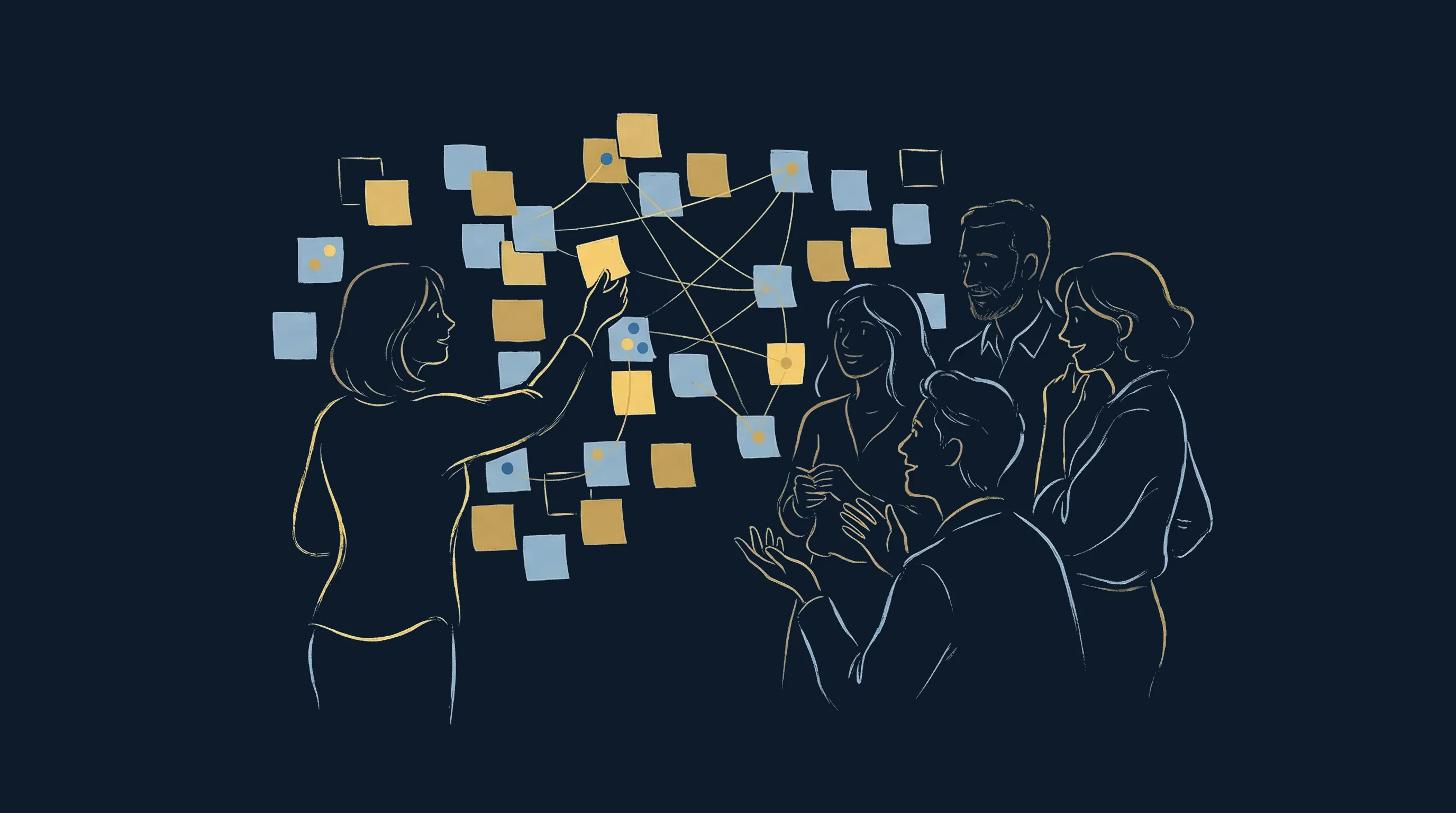
TRIP sticky-note workshop: each participant lists their daily tasks (1 task = 1 sticky note). An interactive presentation on the levels of AI (LLMs, assistants, agents, workflows) with concrete examples from notarial work, plus a look at hallucinations and keeping a human in the loop. A group workshop with Perplexity: exploring AI opportunities (Group A) and risks and limits (Group B), followed by a joint debrief, rounded out with the regulatory points (Law 25, professional secrecy, Quebec-made tools).
Afternoon: prioritize and plan (3 hours)
A 15-question Kahoot to reinforce the morning's learning. Sorting the sticky notes into 3 columns: Automatable, AI collaboration, 100% human (decision tree). Dot voting: 3 dots per participant on the tasks with the most value (criterion: frequency x time x tediousness).
ROI calculation and prioritization
Simplified ROI calculation: time x frequency x hourly cost x 48 weeks. An impact/effort matrix to place the use cases (quick wins, major projects, nice-to-haves, tasks to avoid). A roadmap over 3 horizons: 30 days (quick wins), 3 months (major project), 6 to 12 months (vision).
Post-workshop follow-up (8 weeks)
8 weekly emails sent to all participants to keep the momentum going: the CRAFT method for prompting, transcribing meetings with AI, choosing the right AI tool, writing an AI use policy, building a first AI assistant, using deep research, keeping a human in the loop, and making AI stick over time.
The results
2
quick wins identified
1
major project approved
~CAD 150,000
in estimated annual savings
The 2 quick wins
Structure the recording and storage of calls and emails to turn them into knowledge the AI can use. Make it easy to find information in past exchanges and to get answers to questions about client files.
Automatic summaries of meetings and files to cut the time spent taking notes and writing minutes.
The major project
An AI phone agent connected to the CRM to open new client files, answer common client questions and route complex calls to the right notary. Estimate: a significant reduction in phone time spent on administrative tasks.
The follow-up program
8 weekly emails to keep the momentum going after the workshop and reinforce the learning over time.
Week 1
The CRAFT method: the secret to a good prompt
Week 2
Transcribing your meetings with AI
Week 3
How to choose the right AI tool
Week 4
Writing an AI use policy
Week 5
Building your first AI assistant
Week 6
Using deep research for your files
Week 7
Human in the loop: staying in control
Week 8
Keeping the momentum: making AI stick over time
Want similar results?
Identifying the use cases that pay off comes before choosing any tool. The training course on high-ROI AI opportunities teaches your decision-makers to spot them.
30 minutes, no commitment.